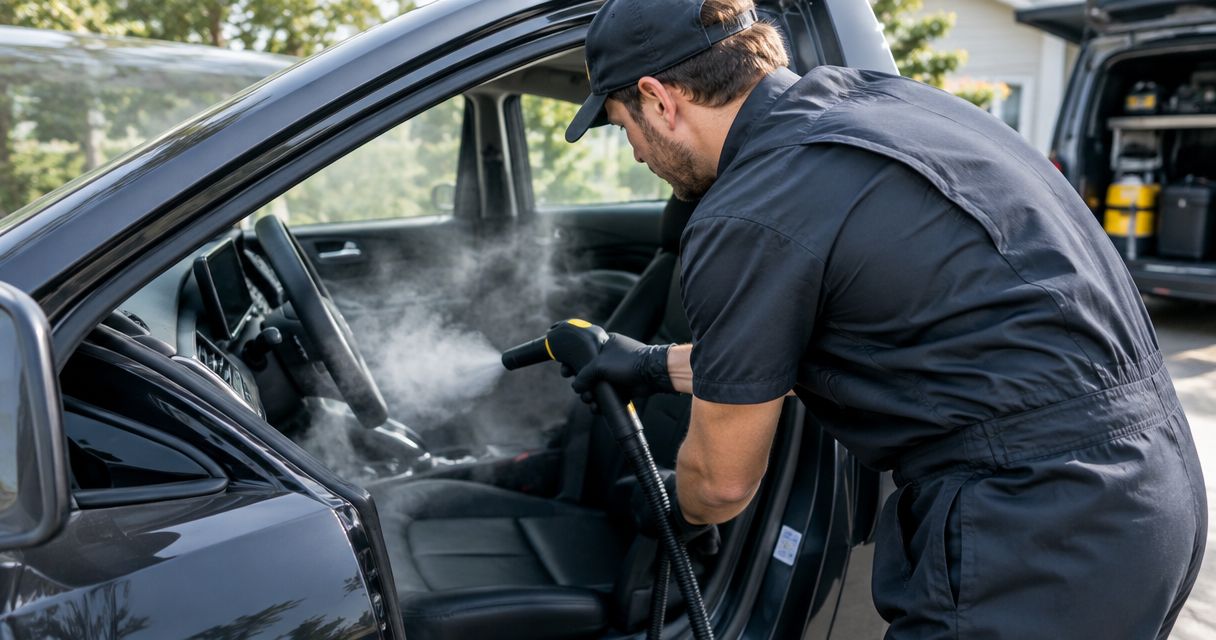
Mobile detailing can remove cigarette smoke smell for the long term when cleaning reaches the contaminated materials and nobody smokes in the car again, but it cannot guarantee permanent removal from every vehicle. A fresh-smelling cabin immediately after treatment does not prove that residue in upholstery, hidden surfaces, or the ventilation system has been removed.
- Can mobile detailing get rid of cigarette smoke smell permanently? Sometimes, but lasting results require removing residue, not covering it.
- Interior detailing should address contaminated surfaces; air fresheners do not remove the source of cigarette odor.
- Spiffy Me provides mobile detailing in Orange County; confirm smoke-removal scope before booking.
- Judge the result after the cabin dries and added fragrances dissipate, not just at handover.
Why this matters
Book for smoke-residue removal, not a temporary change in scent. Cigarette smoke leaves material on interior surfaces, and odor can remain in porous components even when visible dirt is gone. Cleaning the seats alone does not address every possible source.
For your 2026 booking, separate ordinary interior cleaning from smoke-specific work before accepting a quote. The guide to interior detailing products for smoke odor removal provides related reading, but product selection is only part of the decision. You also need to know which surfaces the detailer will treat and which areas fall outside the appointment.
Can mobile detailing get rid of cigarette smoke smell permanently?
Yes, lasting removal is possible, but permanent removal is an outcome to assess, not a promise to assume. The important distinction is whether the service removes the odor source or merely makes the cabin smell different.
A sound process follows this order:
- Inspect the cabin. Identify the smoking history, affected materials, strongest odor locations, and evidence of previous treatments.
- Remove loose contamination. Clear ash, discarded smoking materials, debris, and contaminated removable belongings before wet cleaning.
- Clean compatible surfaces. Address upholstery, carpet, mats, trim, glass, and other affected areas using material-appropriate methods.
- Assess ventilation. Check whether odor is associated with the cabin filter or airflow, and identify work requiring separate attention.
- Dry and reassess. Evaluate the cabin after cleaning moisture and added scents no longer obscure the result.
This sequence explains why a basic vacuum and fragrance treatment is not equivalent to smoke remediation. It also gives you a practical way to compare service descriptions without relying on before-and-after photographs.
What does permanent removal actually mean?
For a car owner, permanent removal means the original cigarette odor does not return during normal use without new smoking exposure. No single handover inspection establishes that outcome for every contaminated material.
Ask what the provider considers a successful result and how it handles remaining odor. Keep the distinction between an odor assessment and a health assessment clear: a car that smells better is not automatically proven free of tobacco residue.
Which treatments remove residue, and which only change the smell?
Different methods serve different purposes. Use this comparison when reviewing a 2026 service description; it is not a list of treatments confirmed as available from any particular provider.
| Approach | Best for | What it contributes | Main limitation |
|---|---|---|---|
| Material-appropriate surface cleaning | Removing accessible residue | Cleans affected hard surfaces and compatible interior materials | Cannot reach contamination concealed behind trim or inside components |
| Upholstery and carpet extraction | Cleaning compatible fabric and carpet | Removes cleaning solution and loosened soil from suitable materials | Requires controlled moisture and drying; not appropriate for every surface |
| Cabin filter assessment | Investigating odor associated with airflow | Identifies a filter that needs attention | Does not clean upholstery, ductwork, or the rest of the cabin |
| Odor-treatment add-on | Addressing residual odor after cleaning | Provides a separate treatment when appropriate to the method and vehicle | Does not establish that physical residue has been removed |
| Air freshener | Adding a preferred scent | Changes how the cabin smells | Does not remove cigarette residue |
Choose source cleaning before scent. A treatment that improves the smell has value only if you understand what it does and what remains untreated.
Do not assume that more aggressive equipment means a better result. The method must fit the material, the contamination, and the safety requirements. A headliner, for example, needs different handling from a removable floor mat.
Why cigarette smoke removal results vary
The service location does not determine whether smoke odor stays gone. Contamination depth, access, and the scope of cleaning matter more than whether the technician works at your property or in a shop.
- Smoking history: Repeated smoking creates more opportunities for residue to accumulate across the cabin. Describe the history accurately rather than calling every case a light odor.
- Affected materials: Fabric, carpet, foam, headliners, and hard trim require different cleaning decisions. A method suitable for one surface is not automatically suitable for another.
- Hidden sources: Contamination beneath seats, around tracks, behind accessible trim, or within layered materials can remain after visible surfaces look clean.
- Ventilation involvement: Odor associated with airflow needs separate investigation. A cleaned seat does not resolve an untreated source elsewhere.
- Drying and re-exposure: Remaining moisture complicates assessment, while smoking again introduces new contamination. Neither condition supports a reliable permanence claim.
These factors also explain why two cars with similar visible interiors can need different work. Send useful details before the appointment, then let the inspection determine the scope instead of asking for a universal treatment promise.
How should you assess a smoke-removal service before booking?
For a 2026 appointment, ask for a written scope that distinguishes cleaning, odor treatment, and any separate repair or replacement work. A clear exclusion is more useful than an unsupported guarantee.
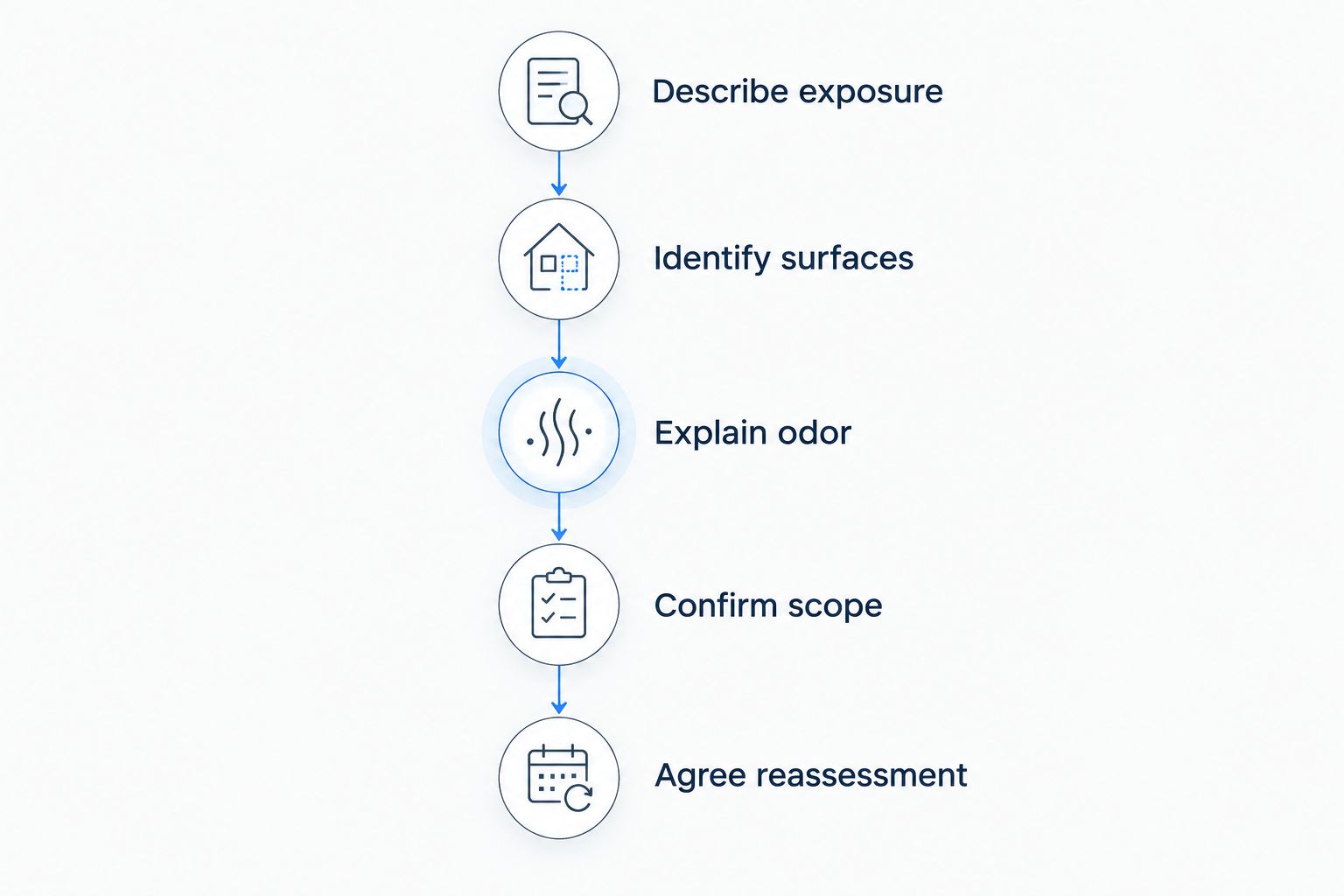
Use the following sequence when requesting an assessment:
- Describe exposure. State whether smoking happened once or repeatedly, whether it still happens, and whether the car was purchased with the smell.
- Identify surfaces. Describe the upholstery and mention affected mats, carpet, headliner, seat belts, and storage areas.
- Explain odor. Say whether it is noticeable on entry, after the car sits closed, or when the ventilation runs.
- Confirm scope. Ask what gets cleaned, what needs separate attention, and whether any fragrance or odor-treatment process is proposed.
- Agree reassessment. Establish how and when you will evaluate the dried cabin and discuss remaining odor.
Send photographs of visible ash, staining, and affected areas when requesting a quote. Photos help explain the condition, but they cannot communicate odor or reveal contamination inside upholstery. An inspection still matters.
Spiffy Me mobile detailing is best suited to Orange County car owners seeking interior or exterior cleaning at their location. For cigarette smoke, ask whether the proposed appointment addresses your specific odor problem; the verified service description does not establish a smoke-removal method or permanent-result guarantee.
You can use Spiffy Me to request a quote and ask how to book. Include the vehicle condition and smoke history rather than requesting an ordinary interior clean and disclosing the odor on arrival.
Request an interior detailing quote
Describe the smoke history and ask which affected areas the proposed service addresses.
What should a smoke-removal quote explain?
A useful 2026 quote defines the work, not just the desired smell. Ask the provider to distinguish the initial cleaning scope from anything that depends on inspection findings.
Look for clear answers to these questions:
- Which interior surfaces are included, and which are excluded?
- Are headliner cleaning and seat-belt cleaning appropriate for this vehicle?
- Does the appointment include a cabin filter assessment, or is that separate?
- Will the process introduce fragrance that affects your ability to assess the result?
- What access, work area, and drying arrangements does the mobile appointment require?
- What happens if cigarette odor remains after the cabin has dried?
Do not interpret the word detailing as confirmation that every item is included. Likewise, do not assume that a smoke-related concern means the provider will remove seats, dismantle ventilation components, or replace interior materials.
Keep any follow-up terms in writing. Ask what the provider will reassess rather than assuming a return visit, additional treatment, or replacement work is included.
Can the smoke smell come back after detailing?
Smoke smell can return after detailing when odor-bearing material remains or smoking resumes. A pleasant scent at collection is not enough to distinguish residue removal from temporary masking.
Assess the interior after it has dried, without immediately adding an air freshener. Notice whether the odor comes from one area, appears when ventilation runs, or becomes noticeable after the vehicle sits closed. Report those observations to the provider rather than simply saying the entire service failed.
A localized problem calls for a localized reassessment. Repeating the same scent treatment without investigating the source does not explain why the odor returned.
Does ozone permanently remove cigarette smell from a car?
Ozone does not guarantee permanent cigarette-smoke removal and does not replace physical cleaning. The U.S. Environmental Protection Agency's guidance on ozone generators warns that ozone is a lung irritant and that concentrations meeting public-health standards have little potential to remove many indoor contaminants.
Do not run an ozone generator in an occupied vehicle or treat a strong ozone smell as evidence that the cabin is safe. If a provider proposes ozone, ask about the purpose, operating controls, ventilation, and re-entry instructions. Do not choose a treatment based on an unsupported promise that it sterilizes every interior material.
How do you check whether smoke removal worked?
Check the dried cabin without added fragrance, then assess it during ordinary use. Your 2026 handover checklist should focus on the original cigarette smell, not whether the technician left a pleasant scent.
Inspect removable mats and accessible storage areas. Check the seats, carpet, and headliner without soaking or scrubbing them yourself, and note whether ventilation changes the odor. Avoid judging success while upholstery is still damp.
Record where you notice remaining odor and describe it consistently. Useful observations help the provider distinguish an untreated source from a separate damp smell, a fragranced product, or new smoke exposure.
FAQ
Can mobile detailing get rid of cigarette smoke smell permanently?
Mobile detailing can achieve lasting cigarette-smell removal when the odor sources are successfully cleaned and no new smoking occurs. It cannot guarantee permanent removal from every vehicle, especially when contamination remains in inaccessible or deeply affected materials.
Is a regular interior detail enough for a smoker's car?
A regular interior detail is not automatically sufficient for a smoker's car. Confirm which contaminated surfaces the service addresses and whether smoke-specific assessment or separate work is needed.
Will shampooing the seats remove all cigarette odor?
Shampooing the seats does not remove cigarette odor from every part of the cabin. Carpet, headliner, hard surfaces, removable items, and ventilation-related sources also need consideration.
Does changing the cabin air filter fix smoke smell?
Changing a contaminated cabin air filter addresses that component, not the entire smoke-contaminated interior. Odor remaining in upholstery or other surfaces requires separate attention.
Can I use air freshener after smoke-removal detailing?
Assess the cleaned cabin without air freshener first. Added scent can obscure remaining cigarette odor and make the result harder to judge.
Does Spiffy Me guarantee permanent cigarette-smell removal?
A permanent cigarette-smell removal guarantee is not established by Spiffy Me's provided service information. Ask for the proposed cleaning scope and any follow-up terms before booking.
Does a car with no cigarette smell have no tobacco residue?
A car without a noticeable cigarette smell is not automatically proven free of tobacco residue. Odor assessment and confirmation that contaminants are absent are different questions.
One last thing
Ask for the final odor check before adding a finishing fragrance. That simple request makes the result easier to assess and gives the provider a clearer description if something remains.
If you are preparing the vehicle for sale, describe the work performed rather than claiming the car has never been smoked in. Cleaning changes the condition; it does not change the vehicle's history.


