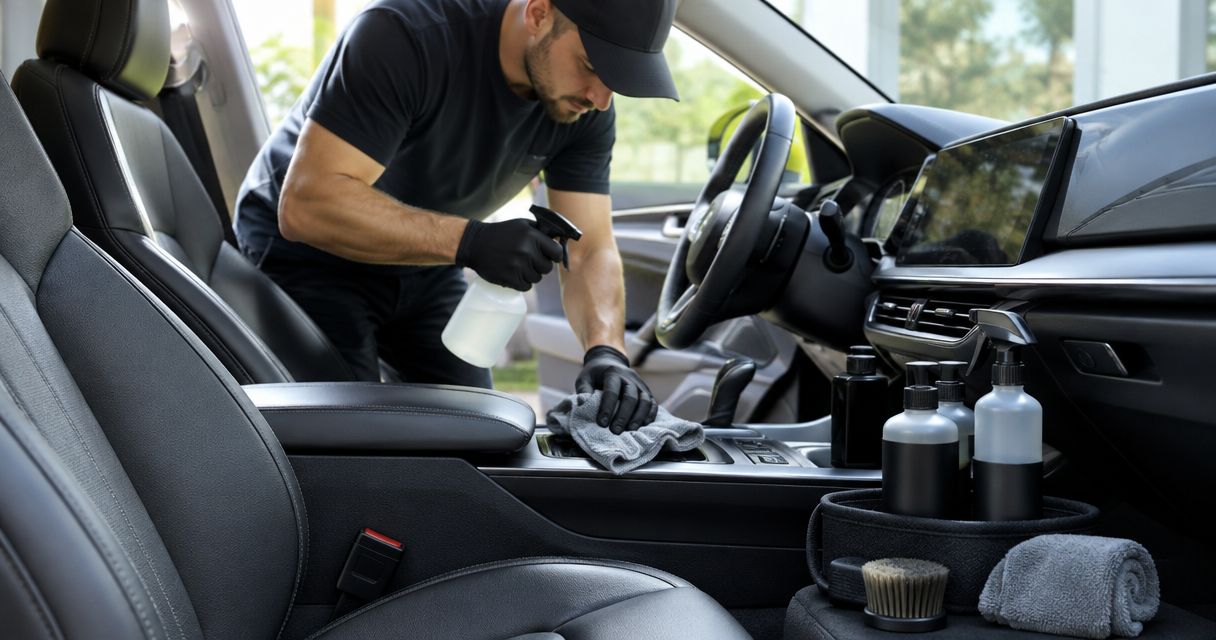
Best overall for smoky fabric: upholstery extraction detergent. Best first step for hard surfaces: a material-safe interior cleaner. Best finishing aid: activated carbon. This 2026 guide ranks the best interior detailing products for smoke odor removal by the surface or problem each one addresses—not by fragrance strength.
- The best interior detailing products for smoke odor removal clean residue before treating lingering odors.
- Upholstery extraction detergent is the first choice for washable fabric, not leather or headliners.
- Material-safe interior cleaners address smoke residue on compatible hard surfaces.
- Activated carbon supports odor control after cleaning; it does not remove deposited smoke residue.
- Spiffy Me offers mobile interior detailing for Orange County car owners seeking service instead of DIY cleaning.
Why this matters
Smoke odor removal is a cleaning problem before it is a deodorizing problem. Tobacco smoke leaves residue on surfaces and in porous materials; an air freshener changes what you smell without removing that residue.
Choose products around the affected material. A fabric-cleaning detergent, a leather cleaner, and an odor-control product perform different jobs, so buying one bottle for the entire cabin is the wrong starting point.
Spiffy Me is a mobile interior detailing option for Orange County car owners who prefer service to DIY cleaning. Visit Spiffy Me to request a quote, and describe the smoke exposure rather than asking only for a general interior clean.
What makes the best smoke odor removal products
For this 2026 guide, the deciding criteria are material compatibility and source cleaning. A strong scent is not evidence of smoke removal.
- Material compatibility: The label must cover the surface you intend to clean. Fabric, leather, screens, and headliners need separate checks.
- Residue removal: Give priority to products that clean deposited contamination rather than cover its smell.
- Application control: You need a way to limit moisture and keep cleaner away from seams, electronics, and adhesives.
- Removal instructions: Check whether the product requires wiping, rinsing, or extraction. Leaving cleaner behind creates another problem.
- Odor assessment: A low-fragrance or fragrance-free product makes it easier to judge the remaining smoke odor.
- Safety directions: Follow the label for ventilation, protective equipment, dilution, and surface testing.
Start with 1 hidden test area before treating a visible section. This is a practical application check, not a guarantee that every part of an older or repaired interior will respond identically.
Smoke odor removal products at a glance
These are product types, not interchangeable substitutes. Read each product's actual label before buying or using it.
| Rank and product type | Best for | Standout function | Key limitation |
|---|---|---|---|
| 1. Upholstery extraction detergent | Washable fabric seats and carpets | Cleans fabric with a compatible extraction process | Unsuitable for leather; excess moisture is a risk |
| 2. Material-safe interior cleaner | Compatible hard trim and contact surfaces | Removes surface soil and smoke residue | Does not clean contamination inside cushioning |
| 3. Dedicated leather cleaner | Leather seats and trim | Cleans leather using material-specific directions | Cannot reach smoke contamination beneath the seat covering |
| 4. Activated carbon odor absorber | Residual airborne odors after cleaning | Adsorbs some odor-causing compounds | Does not remove residue from cabin surfaces |
| 5. Fragrance-free odor neutralizer | Targeted follow-up on approved materials | Treats odors within its stated label scope | Effectiveness and compatibility depend on the formulation |
1. Upholstery extraction detergent: best for smoky fabric
Upholstery extraction detergent is the first choice when washable fabric seats or carpeting are the main odor source. It works within a cleaning process that applies solution and removes dirty liquid with compatible equipment. The detergent alone is not the entire treatment.
Check both the vehicle's care instructions and the detergent label. A product approved for carpeting is not automatically approved for every automotive seat fabric, and extraction is not a default method for a headliner.
Upholstery extraction detergent pros:
- Targets contaminated fabric rather than only the surrounding air.
- Supports removal of loosened soil through extraction.
- Lets you treat affected sections instead of spraying the entire cabin.
Upholstery extraction detergent cons:
- Requires compatible equipment and controlled moisture.
- Leaves the job unfinished if the material stays damp.
- Does not address residue on hard trim or inside inaccessible areas.
Best for: Washable cloth seats, carpet, and compatible removable mats with smoke exposure.
Remove loose debris before wet cleaning, and follow the specified dilution rather than adding extra detergent. More concentrate is not proof of better cleaning. Excess product also creates more residue to remove.
Verdict: Buy for approved washable fabric; skip for leather and unverified headliner applications.
2. Material-safe interior cleaner: best for hard-surface residue
A material-safe interior cleaner belongs early in the smoke-removal process because residue is not limited to seats. Compatible door trim, consoles, and other cabin surfaces need cleaning too. Screens, clear instrument covers, and sensitive finishes require their own approved care methods.
Choose by the surfaces listed on the label, not by an all-purpose claim on the front of the bottle. Apply it as directed, and keep liquid out of switches, vents, and seams.
Material-safe interior cleaner pros:
- Addresses accessible surface contamination directly.
- Allows controlled cleaning with a cloth rather than broad cabin spraying.
- Complements fabric cleaning instead of duplicating it.
Material-safe interior cleaner cons:
- Cannot remove contamination inside seat padding.
- Some formulations are unsuitable for sensitive finishes.
- Residue needs wiping or rinsing according to the label.
Best for: Compatible hard interior surfaces carrying smoke film or general soil.
Keep 2 clean microfiber cloths available: one for applying or working the cleaner and another for the required final wipe. Replace either cloth when it becomes dirty; spreading contaminated cleaner defeats the purpose.
Verdict: Buy as the hard-surface cleaning step, not as a complete smoke-odor solution.
3. Dedicated leather cleaner: best for leather seats
Dedicated leather cleaner is the appropriate starting category when the affected seating is leather. Check the leather type and finish before applying it. Automotive leather can have different coatings, repairs, and care requirements, so the word leather on a bottle is not enough.
Cleaning removes accessible surface soil. It does not establish that smoke contamination in seams, backing materials, or cushioning has been removed.
Dedicated leather cleaner pros:
- Gives you material-specific application instructions.
- Supports controlled cleaning of seat contact areas.
- Avoids treating leather as washable upholstery.
Dedicated leather cleaner cons:
- Compatibility still depends on the leather and finish.
- Does not reach contamination beneath the covering.
- Requires extra care around perforations and damaged areas.
Best for: Leather seats and trim that the product label explicitly covers.
Do not substitute conditioner for cleaner. Conditioning and cleaning are different tasks, and adding fragrance or dressing before checking the odor makes the result harder to judge. Keep moisture controlled around stitching and perforations.
For a separate material-focused guide, compare label requirements and application methods before choosing any leather treatment.
Verdict: Buy for compatible leather surfaces; skip fabric detergent as a substitute.
4. Activated carbon odor absorber: best after source cleaning
Activated carbon adsorbs some airborne compounds onto its porous surface. That makes it a supporting odor-control option after you have cleaned the cabin. It does not wash smoke residue off a dashboard or remove contamination from seat fabric.
Use a contained product intended for the setting, following its placement and replacement directions. Do not spread loose carbon around the interior.
Activated carbon odor absorber pros:
- Provides an odor-control option without relying on perfume.
- Works without wetting interior surfaces.
- Fits a follow-up stage after cleaning and drying.
Activated carbon odor absorber cons:
- Does not replace source cleaning.
- Performance depends on the product, exposure, and conditions.
- Does not provide proof that the cabin is free of smoke residue.
Best for: Supplementary odor control in a cleaned, dry interior.
Avoid judging the whole detailing job by whether an absorber has been installed. If a particular seat or carpet section still smells smoky, return to that material's cleaning requirements instead of adding more absorbers.
Verdict: Buy as a finishing aid; skip as the sole treatment for a smoke-contaminated cabin.
5. Fragrance-free odor neutralizer: best for targeted follow-up
A fragrance-free odor neutralizer is a follow-up option only when its label covers the odor and material involved. Odor neutralizer is a broad product description, not a single chemical formula. Read the stated use carefully before applying it to automotive textiles or trim.
Choose this category after cleaning, drying, and identifying the remaining odor source. Do not assume a product designed for pet accidents also treats smoke residue.
Fragrance-free odor neutralizer pros:
- Avoids adding perfume while you assess the result.
- Supports targeted treatment where the label permits it.
- Offers a separate follow-up step without repeating an entire cleaning process.
Fragrance-free odor neutralizer cons:
- Formulations have different uses and limitations.
- Some products require direct contact with the odor source.
- Spraying the cabin cannot substitute for removing contamination.
Best for: A remaining, identifiable odor on a surface explicitly covered by the product.
Test first and follow the application amount on the label. Repeated spraying without reassessment adds product but does not establish that the original problem has changed.
Verdict: Hold until source cleaning is complete and the remaining treatment need is clear.
How to use the products in the right order
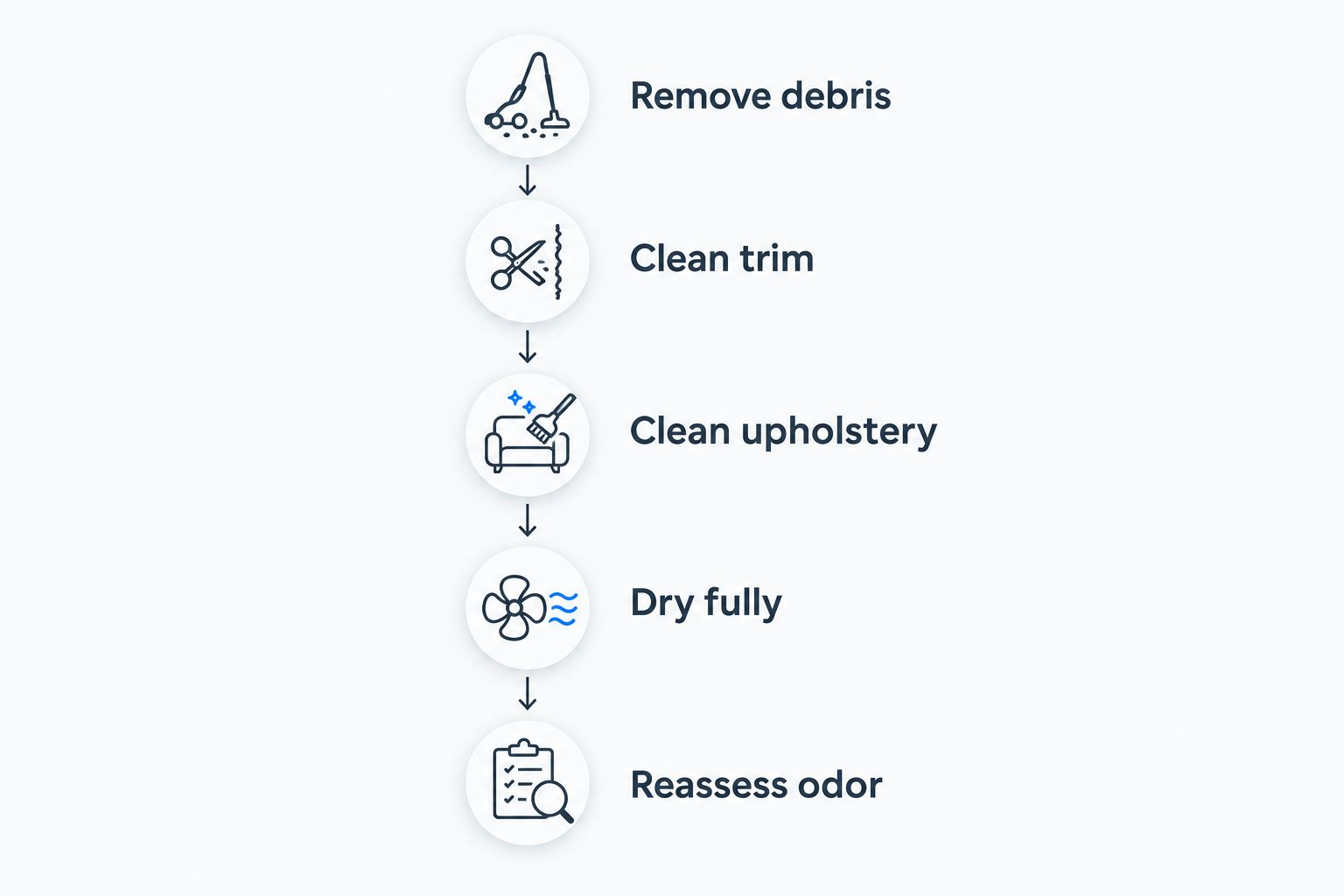
The practical sequence for 2026 is source cleaning, drying, then reassessment. Keep the steps separate so you can tell what remains instead of masking the result.
- Remove debris: Empty ash and loose contamination, and remove personal belongings before cleaning.
- Clean trim: Treat compatible hard surfaces using controlled application.
- Clean upholstery: Use the method approved for fabric or leather; treat the headliner separately.
- Dry fully: Follow the cleaning and equipment instructions before evaluating the cabin.
- Reassess odor: Identify remaining problem areas before adding an odor-control treatment.
If the odor is associated with ventilation airflow, check the vehicle manufacturer's cabin-filter maintenance instructions. Replacing a filter does not clean the rest of the interior or establish that contamination elsewhere in the ventilation system is resolved.
Do not substitute an ozone generator for this process. The U.S. Environmental Protection Agency warns that ozone can harm health and that concentrations meeting public-health standards have little potential to remove many indoor contaminants.
How the ranking works
This 2026 ranking puts direct surface cleaning ahead of supplementary odor control. Upholstery detergent ranks first for washable fabric; interior cleaner and leather cleaner occupy separate material-specific roles. Activated carbon and neutralizers follow because they do not replace removal of deposited residue.
The order is a buying decision tree, not a claim that one formula cleans every cabin. Choose the first product that matches the affected material, then add only the supporting steps the job requires.
Which smoke odor removal products should you choose?
For cloth seats and carpet, start with approved upholstery cleaning and extraction. For leather seating, choose compatible leather cleaning instead. In either cabin, clean accessible hard surfaces before assessing whether you need an odor-control product.
For a 2026 service quote, send 3 details: your vehicle, the smoke history, and the affected areas. Include whether the odor is concentrated around a seat, headliner, carpet, or ventilation airflow. Ask what cleaning is included and which areas require separate attention.
Spiffy Me offers mobile interior detailing in Orange County. Describe the smoke issue when requesting a quote, confirm location coverage, and agree on the scope before booking; do not treat a general detailing service description as a smoke-removal guarantee.
Request an interior detailing quote
Share your vehicle, location, and smoke-odor concerns when requesting service.
FAQ
What are the best interior detailing products for smoke odor removal in 2026?
The best starting products are material-compatible cleaners that remove smoke residue: upholstery extraction detergent for washable fabric, interior cleaner for approved hard surfaces, and leather cleaner for compatible leather. Add odor-control products only after cleaning and drying.
Will an air freshener remove cigarette smoke odor from my car?
An air freshener adds scent but does not remove deposited smoke residue. Clean the affected surfaces before judging whether the original odor remains.
Is activated carbon better than an odor neutralizer?
Activated carbon and odor neutralizers perform different jobs. Carbon adsorbs some airborne compounds, while a neutralizer must be selected according to its specific label claims and material compatibility.
Can I use upholstery cleaner on a smoky headliner?
Use upholstery cleaner on a headliner only if the product and vehicle care instructions permit that application. Do not assume that a seat-extraction method is suitable for the headliner.
Do enzyme cleaners remove cigarette smoke odor?
Do not choose an enzyme cleaner for smoke solely because it treats other odors. Check whether its label explicitly covers smoke and the surface you intend to treat.
Should I use an ozone machine inside my car?
Do not use an ozone machine as a substitute for cleaning smoke residue. The U.S. Environmental Protection Agency warns that ozone can harm health; start with material-safe cleaning instead.
Can I request mobile interior detailing for a smoky car in Orange County?
Spiffy Me provides mobile interior detailing for Orange County car owners. Describe the smoke exposure, confirm coverage for your location, and ask about the proposed treatment scope before booking.
One last thing
Check the headliner before repeating a seat treatment. Smoke contamination is not limited to the surfaces you touch, and a clean-looking seat does not identify the remaining odor source. For your 2026 cleaning plan, inspect overlooked areas and use their approved care methods rather than repeating the same product everywhere.


