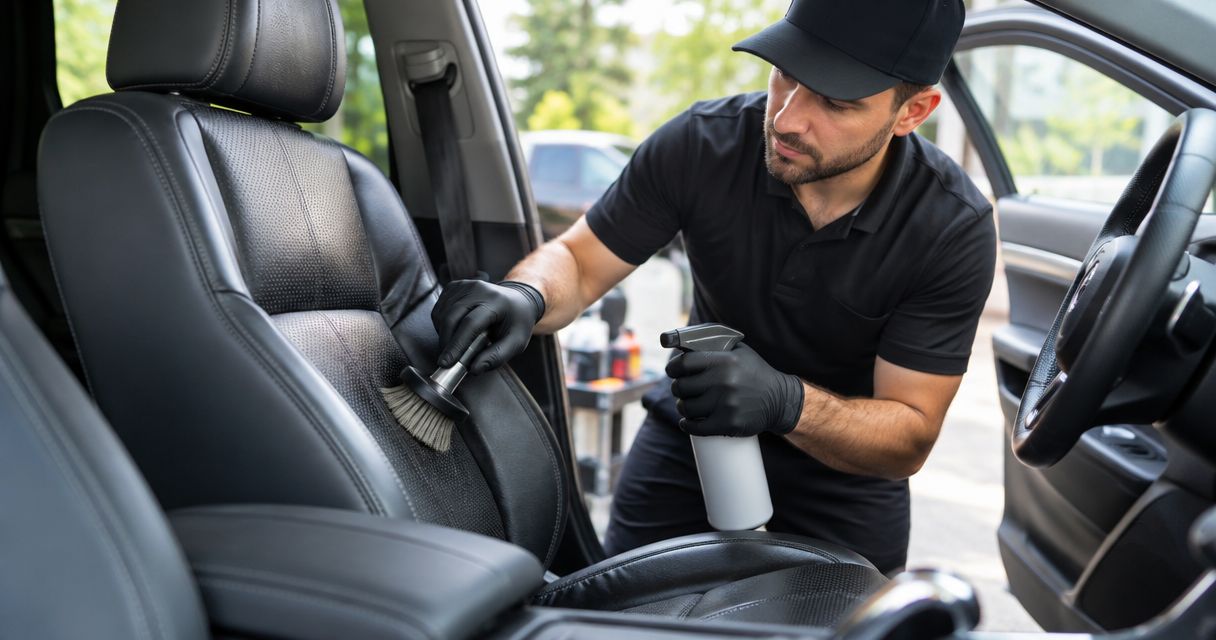
Yes, mobile detailing is safe for leather seats when the cleaning method matches the upholstery, moisture stays controlled, and the detailer follows your vehicle manufacturer’s care instructions. The main risks are unsuitable chemicals, aggressive scrubbing, excessive heat, and soaking—not whether the work happens at your home or in a shop.
- Is mobile detailing safe for leather seats? Yes, when the method matches the upholstery and its condition.
- Follow your vehicle manufacturer’s leather-care instructions before choosing cleaners, conditioners, or steam treatments.
- Spiffy Me offers mobile interior detailing for Orange County car owners; confirm leather-seat treatment before booking.
- Cleaning removes surface dirt; it does not repair cracked leather, peeling finishes, or damaged stitching.
Is mobile detailing safe for leather seats?
Yes—judge the cleaning process, not the mobile setup. Safe leather-seat cleaning starts with identifying the material, inspecting its condition, and selecting a compatible method. A mobile appointment does not remove those requirements, and a shop appointment does not replace them.
Use this sequence before authorizing leather-seat cleaning:
- Identify the upholstery. Check the owner’s manual or vehicle specification rather than assuming every seating surface is leather.
- Inspect existing damage. Point out cracks, peeling, loose stitching, previous repairs, and stains before cleaning starts.
- Confirm the method. Ask which cleaner, tools, moisture controls, and drying approach the detailer proposes.
- Check compatibility. Follow the manufacturer’s instructions and test a suitable inconspicuous area before treating visible surfaces.
- Inspect the result. Check for residue, damp seams, altered color, and an unexpectedly slippery finish before using the seats.
Spiffy Me is for Orange County car owners who want mobile interior detailing. You can review Spiffy Me and ask specifically about your upholstery before agreeing to the work; the service category alone does not establish which leather treatments are included.
Why this matters
A seat can look dirty because of removable soil, but it can also look uneven because its surface finish is worn. Those are different problems. Treating wear as stubborn dirt encourages repeated scrubbing without addressing the damage.
For your 2026 appointment, describe the problem rather than asking only for a deep clean. Say where the mark is, whether the surface feels sticky, and whether previous cleaning changed its appearance. That gives the detailer a clearer starting point.
The goal is clean upholstery without unnecessary changes to its finish or feel. A stronger chemical or a shinier result is not proof of better leather care.
Which seat materials need different cleaning methods?
Vehicle interiors can combine leather, synthetic upholstery, and other materials on the same seat. Appearance alone is not a dependable guide. Confirm the material before choosing a treatment, especially on replacement seats or previously repaired panels.
| Upholstery or condition | Best for | Practical benefit | Limitation or caution |
|---|---|---|---|
| Intact coated automotive leather | Routine cleaning according to the owner’s manual | Compatible surface cleaning removes accumulated soil | Aggressive abrasion can damage the surface finish |
| Perforated leather | Controlled cleaning that keeps liquid out of openings | Careful application addresses surface dirt without deliberately flooding holes | Openings and seams require extra moisture control |
| Suede-like or specialty upholstery | Material-specific care | A matching method respects the material’s texture | Ordinary smooth-leather products are not automatically suitable |
| Synthetic leather upholstery | Cleaning approved for the synthetic material | Correct identification avoids unnecessary leather treatments | A product labeled for leather is not proof of compatibility |
| Cracked, peeling, or repaired upholstery | Assessment before cleaning | Identifying damage sets realistic expectations | Detailing does not restore missing finish or repair structural damage |
These are care situations, not interchangeable service packages. Ask the detailer to explain which situation applies to your car and where the proposed treatment stops.
What if only part of the seat is leather?
Treat each material according to its own care instructions. A seating surface, side bolster, and trim panel do not automatically need the same product simply because they share a color.
If you cannot identify the material, send the vehicle details and clear photographs first. Do not approve an all-purpose treatment based only on the word leather.
Why leather-seat cleaning safety varies
The safety of a leather-seat detail depends on the material and the work performed. These factors matter more than the appointment location:
- Upholstery type. Smooth coated leather, perforated surfaces, synthetic upholstery, and specialty materials need compatible care.
- Existing condition. Cracked finishes, peeling areas, loose seams, and previous repairs change what cleaning can reasonably achieve.
- Product compatibility. Cleaner labels and vehicle care instructions should agree; a general leather-care claim is not enough.
- Mechanical action. Brush stiffness, scrubbing pressure, and repeated passes affect how aggressively a surface is treated.
- Moisture control. Liquid should not be allowed to collect in perforations, seams, or nearby controls.
- Working conditions. Surface temperature and a suitable place to work affect the cleaning process; direct sun is not a substitute for controlled drying.
Use these factors when comparing interior-detailing quotes in 2026. A clear explanation of the process is more useful than an undefined promise to make the seats look new.
What should a careful leather-seat detail include?
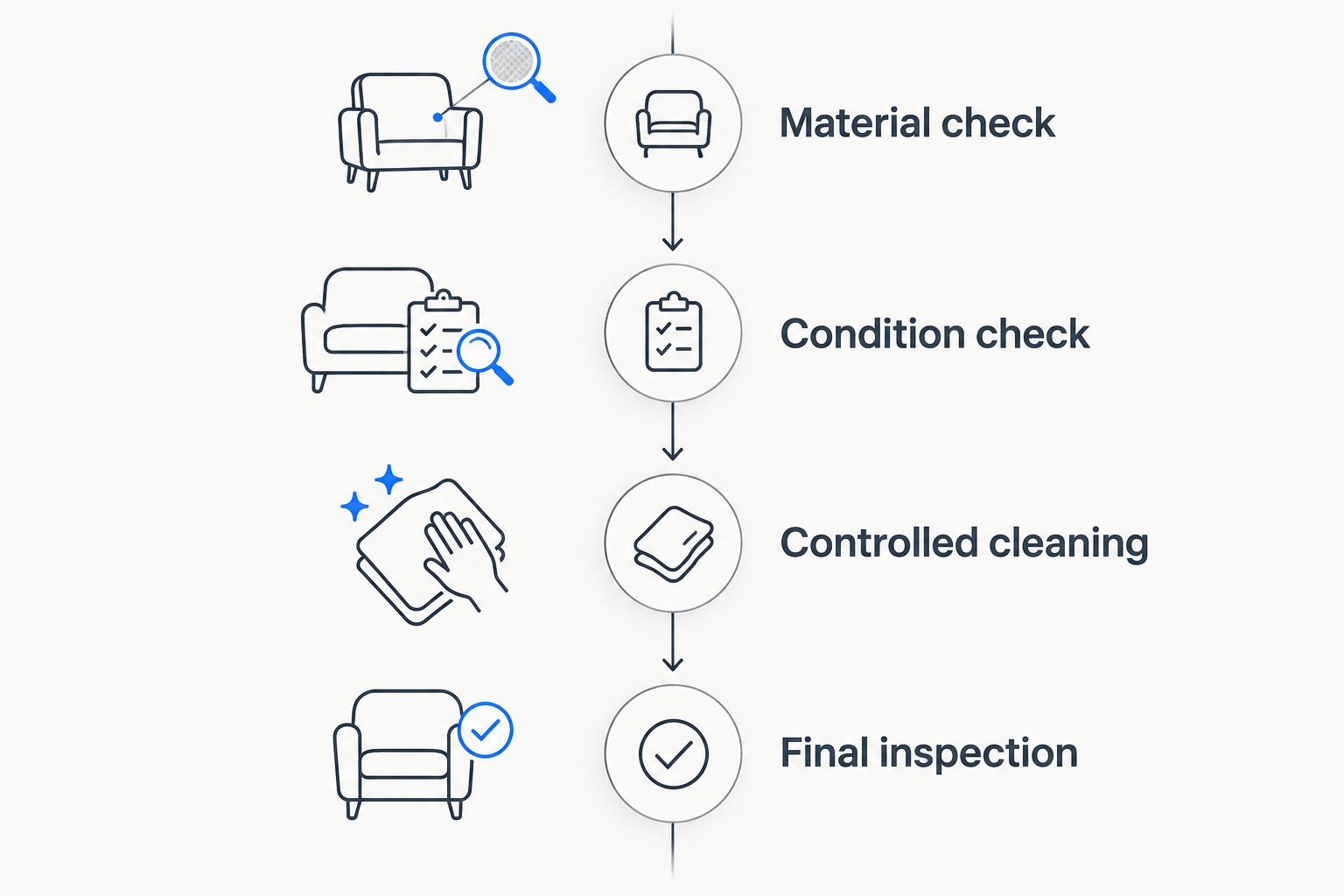
A careful process moves from inspection to compatible cleaning, then checks the result. It does not start with the strongest available treatment. Ask the provider to explain the following stages in plain language.
Material check
Start with the owner’s manual and the actual upholstery. Tell the detailer about replacement panels, aftermarket seat covers, or previous repairs that change how a surface should be treated.
You do not need to identify a leather finish by touch. You do need to flag uncertainty before a chemical or tool reaches the seat.
Condition check
Record visible damage before work starts. Pay particular attention to entry-side bolsters, seat edges, seams, and areas where the finish already looks thin or uneven.
A condition check protects expectations as well as the upholstery. A clean seat can still have wear, and that does not mean the detail was incomplete.
Controlled cleaning
Loose debris should be removed without dragging grit across the upholstery. Cleaning should then use a compatible product and tools suited to the surface, with liquid controlled around seams and perforations.
Ask what happens if a stain does not respond. Stopping before damage is better than escalating pressure simply to chase a mark.
Final inspection
Check the cleaned surface for residue, unexpected color changes, and remaining dampness. Ask whether any applied treatment has use restrictions before you sit down or install a child seat.
Do not assume every interior detail includes conditioning or a protective treatment. Those are separate questions, and suitability depends on the upholstery and manufacturer’s guidance.
What should you ask before booking in 2026?
Ask questions that establish the work, its limits, and what you need to prepare. A useful answer names the method or explains how the provider will choose it after inspection. A promise that every seat receives the same treatment does not address material differences.
- What upholstery information do you need before quoting?
- Does the interior service include cleaning the seating surfaces?
- How will you handle perforations, seams, and existing damage?
- Will you follow my vehicle manufacturer’s care instructions?
- Is any conditioner or protectant proposed, and why is it suitable?
- What stains or damage fall outside the cleaning service?
- What workspace and vehicle access do you need?
- What should I check before using the seats afterward?
For a practical quote request, send 3 photos: the whole seating area, a close-up of the problem, and a view showing any existing damage. This is a preparation recommendation, not a required submission format or a guarantee that photographs replace an inspection.
Include the vehicle’s make and model, the affected seats, and any known spill or previous treatment. Keep the request specific: cleaning an intact seat and assessing a peeling bolster are different tasks.
You can contact Spiffy Me to request a quote for mobile interior detailing in Orange County. Ask the business to confirm your location, the proposed leather-seat work, and booking arrangements before treating the appointment as scheduled.
Can mobile detailing damage leather seats?
Mobile detailing can damage leather seats when the method is unsuitable. So can cleaning performed in a shop or at home. The relevant warning signs are incompatible chemicals, excessive abrasion, uncontrolled moisture, and treatment of damaged areas without assessment.
Before cleaning, complete 2 checks: confirm the upholstery type and identify existing damage. These checks do not guarantee an outcome, but they address basic questions that should not be skipped.
If a provider cannot explain the proposed treatment, pause the booking. You should understand what will touch the seat and what the work is intended to accomplish.
Does leather conditioner make detailing safer?
Leather conditioner is not automatically necessary or suitable for every vehicle seat. Follow the vehicle manufacturer’s guidance and the treatment’s compatibility instructions rather than assuming more product means more protection.
Conditioning also does not repair cracked finishes or peeling material. Ask what the treatment is intended to do and whether it leaves residue or changes the surface feel.
For a 2026 booking, approve the cleaning scope first. Discuss an additional treatment only after the upholstery and its condition are established.
Can detailing remove stains without damaging leather?
Detailing can remove some surface contamination, but stain removal depends on the material, the substance, and the condition of the finish. Permanent discoloration and missing surface finish are not ordinary dirt.
Start by describing the stain accurately. Tell the detailer what spilled, what you already applied, and whether scrubbing has changed the area.
Do not make complete stain removal the condition for a successful clean. Agree that the detailer should stop if further treatment risks damaging the upholstery.
FAQ
Is mobile detailing safe for leather seats in 2026?
Yes, mobile detailing is safe for leather seats when the method suits the upholstery and follows the vehicle manufacturer’s care instructions. Product compatibility, controlled moisture, and existing seat condition matter more than the appointment location.
Should I ask a detailer to steam-clean my leather seats?
Do not request steam by default; first confirm whether your vehicle manufacturer permits it for the upholstery. Ask the detailer to explain compatibility and how heat and moisture will be controlled.
Can a mobile detailer clean perforated leather seats?
Perforated leather seats can be cleaned with a suitable method that controls moisture around the openings. Confirm the proposed approach before work begins rather than assuming it matches ordinary smooth-seat cleaning.
Will detailing fix cracked or peeling leather seats?
Detailing does not repair cracked leather or replace a peeling surface finish. Ask for an assessment that separates removable dirt from damage requiring repair.
Do all leather seats need conditioner after cleaning?
No, leather seats do not all require the same conditioning treatment. Follow the vehicle manufacturer’s instructions and confirm that any proposed product suits the actual upholstery.
Can I sit on my leather seats immediately after detailing?
Use the seats after the detailer confirms they are ready and any treatment instructions permit it. Check for dampness and residue rather than relying on a universal waiting period.
What should I tell a mobile detailer about my leather seats?
Provide the vehicle details, affected seating areas, known damage, and any previous cleaning products or repairs. Clear photographs help communicate the issue, but they do not replace an on-site assessment.
One last thing
A stain that remains is not always a reason to clean harder. Once the problem is worn finish rather than removable soil, more cleaning targets the seat itself.
Make that stopping point part of your 2026 booking conversation. Ask the detailer to flag damage and discuss the next step instead of automatically increasing chemical strength or scrubbing pressure.


