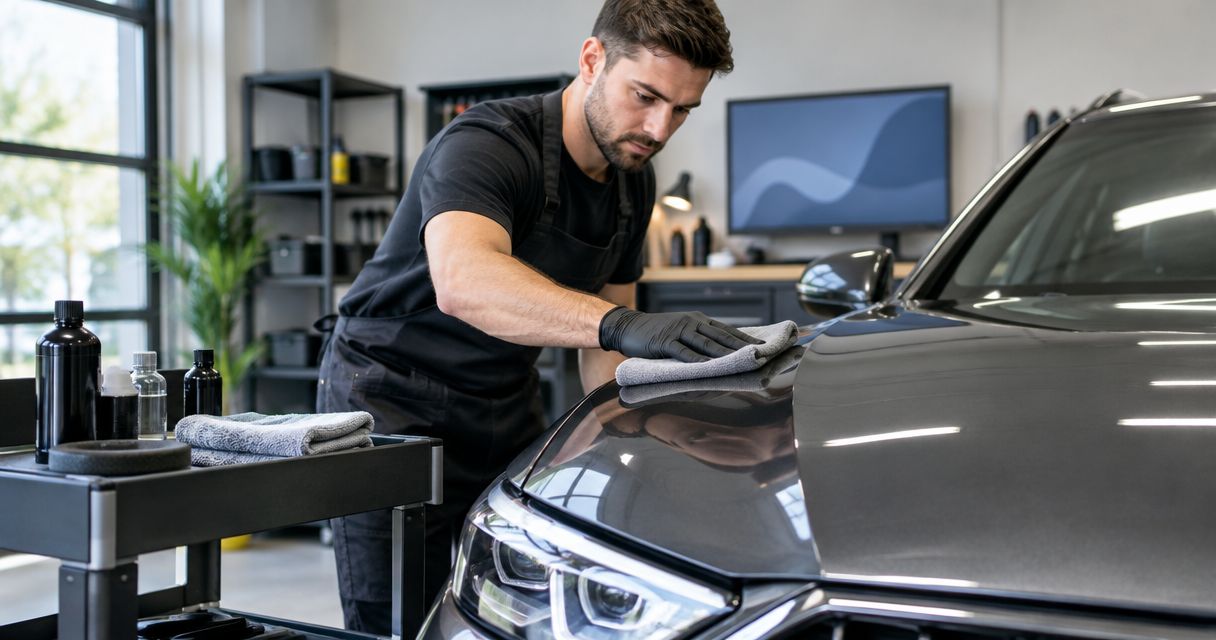
Small business owners’ ceramic coating is a protective treatment for vehicle surfaces with the aim of making routine exterior care easier while maintaining a presentable business vehicle. This guide explains how to assess paint condition, compare protection options, and plan an appointment around the work your vehicle needs to do.
- Ceramic coating for small business owners supports exterior maintenance; it does not replace washing or prevent stone chips.
- Spiffymeofficial provides mobile detailing and ceramic coating services for Orange County car owners.
- Choose protection around paint condition, vehicle use, and maintenance commitments—not a durability claim alone.
- Request a written scope covering preparation, treated surfaces, appointment requirements, and aftercare before booking.
Why ceramic coating matters for small business owners
A business vehicle has competing jobs: transporting you, carrying equipment, and appearing presentable at customer appointments. Ceramic coating addresses exterior surface protection and cleaning, not every part of vehicle upkeep. Choose it for a defined maintenance need, not as a substitute for cleaning or paint repair.
Spiffymeofficial provides mobile interior and exterior detailing and ceramic coatings for Orange County car owners. Spiffymeofficial ceramic coating is best for Orange County car owners seeking mobile service. Confirm your address, vehicle requirements, and coating appointment arrangements when requesting a quote.
Your 2026 decision should start with vehicle use. A client-facing car, a delivery vehicle, and a work truck do not need identical preparation or maintenance plans. Interior dirt, cargo damage, and chipped paint also require different responses; coating the exterior does not resolve those problems.
Keep the business case practical. Identify the surface problem you want addressed, the time you can set aside, and the care you can maintain afterward. You do not need an assumed resale gain or an invented productivity saving to make that decision.
How to plan ceramic coating for your business vehicle
Identify the job your vehicle performs
Start with a simple vehicle-use note you can write yourself. Describe where you park, what you carry, whether customers ride with you, and which areas are hardest to keep clean. This gives a detailer useful context before discussing a treatment.
Separate appearance from physical protection. Easier cleaning and a finished exterior are different goals from preventing rock impacts or repairing scratched paint. A ceramic coating is not a physical film that absorbs road debris.
For a work vehicle, the ceramic coating guide for contractors offers a related use-case framework. Keep the request specific to your own vehicle rather than assuming a contractor-oriented service fits every business.
- List the vehicle’s customer-facing and transport duties.
- Note outdoor parking, road exposure, and loading activity.
- Identify whether exterior dirt or interior condition is the main concern.
- Write down the result you expect from coating.
Inspect the paint before choosing protection
Wash and inspect the vehicle before deciding what it needs. Look in good light at the hood, roof, doors, and areas around handles. Photograph existing marks rather than relying on a description such as bad paint.
Coating is not paint correction. Polishing addresses suitable paint defects; coating adds protection to the prepared surface. Chips, failing clear coat, and other damage require a separate assessment rather than a promise that coating will conceal them.
For a useful first enquiry, send 3 photos: one broad exterior view, one close-up of the main concern, and one view of the largest affected panel. These are a starting brief, not a substitute for inspection.
- Photograph the vehicle after cleaning and drying.
- Identify scratches, chips, dull areas, and visible residue separately.
- Disclose repainting or previous protection treatments you know about.
- Ask which defects need attention before coating.
Define the service scope before requesting a quote
Build your own scope first: the surfaces you want treated, the defects you want assessed, and the outcome you expect. Then ask Spiffymeofficial to assess the vehicle and quote the relevant detailing or ceramic coating work. Professional assessment takes the preparation decision out of guesswork; it does not remove the need to agree on the scope.
For your 2026 quote, separate preparation, coating, and aftercare. A coating name alone does not explain what happens to the paint before application or what you need to do afterward. Ask for a written breakdown rather than comparing headline descriptions.
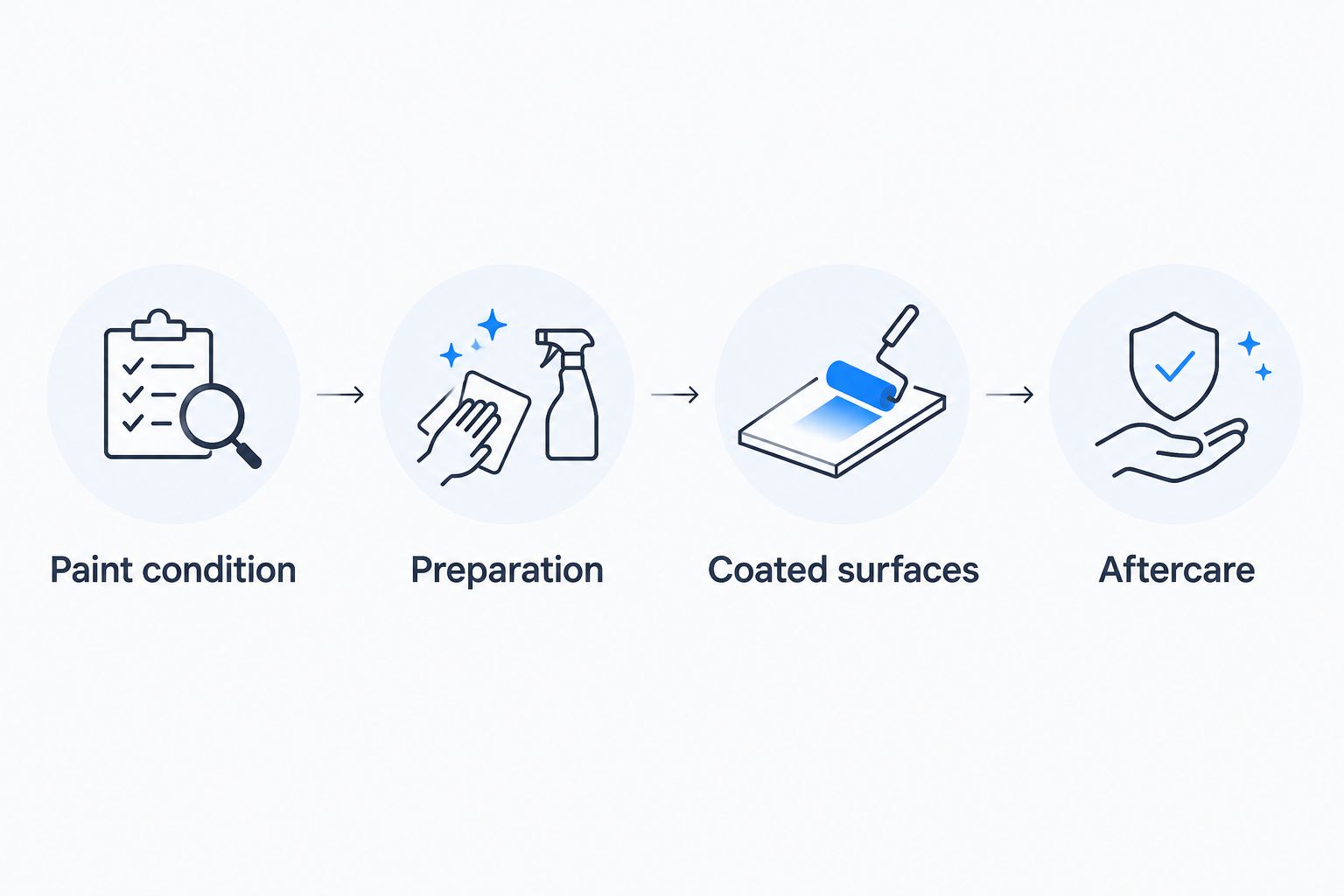
Keep these categories distinct in your enquiry:
- Paint condition: describe existing defects and prior treatments.
- Preparation: ask which cleaning and correction tasks are included.
- Coated surfaces: confirm exactly which areas receive treatment.
- Aftercare: request washing and early-use instructions.
A clear scope makes competing recommendations easier to compare. It also prevents an exterior coating request from being mistaken for interior detailing, glass treatment, wheel treatment, or another service that has not been agreed.
Check the work location and business schedule
Start by checking the parking space yourself. Confirm who controls it, whether service work is permitted, and whether the vehicle can remain there for the agreed appointment. A mobile service still needs a suitable place to work.
Ask Spiffymeofficial which location conditions and vehicle-access arrangements apply to the requested service. Do not assume that every driveway, workplace parking lot, or covered garage is suitable for coating application. Confirm requirements before rearranging your working day.
For a business vehicle, appointment completion and readiness for normal use are separate questions. Request both answers, including any instructions about water exposure, washing, or returning the vehicle to service.
- Confirm permission to use the proposed parking area.
- Describe cover, access, and other site conditions accurately.
- Ask what must be supplied or arranged at the location.
- Separate appointment time from post-application restrictions.
- Move essential equipment out before the agreed appointment.
Compare protection against your actual priority
Use your own priority list before reviewing options. If your main concern is cabin cleanliness, an exterior coating is the wrong starting point. If the concern is stone impacts, compare paint protection film rather than treating ceramic coating as an equivalent.
Ask for an explanation of why a recommended treatment fits the vehicle. Professional ceramic coating combines an application service with the selected coating; a DIY route leaves preparation and application with you. Neither route makes the paint maintenance-free.
When comparing options in 2026, evaluate the whole job: inspection, preparation, application conditions, and aftercare. A treatment that demands care you will not perform is a poor operational fit, even if its description sounds impressive.
- Rank your priority: cleaning, finish, or impact protection.
- Compare equivalent surfaces and preparation scopes.
- Ask what each treatment does not address.
- Check who performs the work and manages application conditions.
- Reject claims that make washing or careful handling unnecessary.
Start with one vehicle and record the handover
If you operate several vehicles, choose 1 vehicle for the initial appointment rather than committing every vehicle at once. This is a planning recommendation, not a claim about how many vehicles a provider handles. It lets you establish the scope and care process before repeating them.
Record the agreed work in a note or spreadsheet you control. Include the vehicle, treated surfaces, preparation performed, appointment date, and instructions received. Keep that record available to anyone responsible for washing or driving the vehicle.
For a 2026 appointment, photograph the exterior at handover and ask about anything you do not understand. Visual inspection helps document the finish; it does not prove coating durability or establish a warranty that was never stated.
- Identify the vehicle and agreed treated surfaces.
- Record preparation and any unresolved paint defects.
- Save the written aftercare instructions.
- Confirm when normal driving and washing can resume.
- Share restrictions with employees who use the vehicle.
Maintain the coating with a repeatable routine
Begin with the installer’s instructions, not an assumed schedule from another coating. Use the specified washing approach and ask which products are compatible. Ceramic coating changes surface behavior, but dirt still accumulates and careless washing can still damage paint.
Assign responsibility instead of leaving cleaning to whoever notices the vehicle first. Make 2 calendar entries: the first permitted wash and a later condition check at an interval agreed with the installer. These are administrative reminders, not universal coating-care timings.
Check the finish after cleaning. Water behavior alone is not a complete diagnosis of coating condition, and adding another product without advice can complicate the assessment. Ask before treating a suspected problem.
- Follow the coating-specific early-care instructions.
- Use clean washing tools and a compatible cleaning method.
- Remove contamination using the recommended procedure.
- Record visible changes after washing, not just when dirty.
- Ask about maintenance before applying additional protection.
Compare options for a small business vehicle
The best option matches the problem you need solved. Use this table to compare protection approaches, then request a scope specific to your vehicle. Preparation and application requirements remain relevant regardless of the treatment you select.
| Option | Best for | Main benefit | Key limitation |
|---|---|---|---|
| Professional ceramic coating | Owners wanting professional preparation and application | Adds surface protection through an agreed service process | Still needs washing; does not prevent stone chips |
| DIY ceramic coating | Owners prepared to handle preparation and application themselves | Gives you direct control over the work | Application quality and working conditions are your responsibility |
| Wax or paint sealant | Owners choosing a renewable exterior protection routine | Provides a protection step within regular exterior care | Requires renewal according to the chosen product’s instructions |
| Paint protection film | Owners prioritizing a physical barrier against road debris | Places a protective film over selected painted areas | Coverage and installation must be specified; it is not damage-proof |
| Exterior detailing without coating | Owners whose immediate priority is cleaning and assessment | Addresses exterior condition before choosing further protection | Does not establish that a ceramic coating has been applied |
Professional application removes the DIY workload, but you still need to approve preparation and manage aftercare. DIY gives you control, but it also makes you responsible for correcting application mistakes. Neither is automatically the better business choice.
Keep expectations separate from purchasing decisions. A clean business vehicle does not prove customer trust, and a coating does not establish a resale return. Judge the service against its agreed surface-care purpose.
Request a vehicle-specific quote
Describe your vehicle, paint condition, Orange County location, and requested detailing or coating work.
Common mistakes small business owners make
Booking protection when cleaning is the immediate need
A dirty cabin or cluttered cargo area needs attention on its own terms. Request interior detailing when the problem is inside the vehicle. Exterior ceramic coating does not clean seats, remove cabin debris, or organize tools.
Comparing quotes without matching the preparation
Two coating descriptions can represent different preparation scopes. Ask each provider to distinguish cleaning, paint correction, and application. Compare the work agreed for your vehicle rather than assuming similar wording means identical service.
Treating mobile service as unrestricted access
Convenient location does not eliminate parking permissions or application requirements. Check the site before booking and disclose access restrictions. Do not schedule customer visits around an assumed completion time that the provider has not confirmed.
Letting employees wash without the care instructions
A coating appointment is only one part of the maintenance process. Share the washing instructions with anyone responsible for the vehicle. Avoid switching cleaning products or methods without checking compatibility.
Buying durability instead of a workable routine
A stated protection period does not explain how your vehicle should be maintained. For a 2026 decision, ask about the conditions behind any durability statement and the care required. Choose a routine you can actually follow.
FAQ
Is ceramic coating worth it for a small business vehicle?
Ceramic coating fits a small business vehicle when exterior protection and manageable routine cleaning are the goals. It does not replace interior detailing, repair damaged paint, or prevent stone chips.
What is the best ceramic coating option for a busy business owner?
Professional application is the better fit when you do not want to manage preparation and coating application yourself. Confirm the work location, service scope, and aftercare requirements before booking.
Does Spiffymeofficial offer ceramic coating in Orange County?
Spiffymeofficial provides mobile auto detailing and ceramic coating services for Orange County car owners. Ask the business to confirm your address and the arrangements for the requested service.
Can I drive my business vehicle immediately after ceramic coating?
Follow the installer’s instructions before returning the vehicle to normal use. Driving, water exposure, and washing restrictions depend on the coating and application process, so confirm them before scheduling work.
Is ceramic coating better than paint protection film for a work truck?
Ceramic coating and paint protection film address different priorities. Coating supports surface protection and cleaning, while film provides a physical barrier over selected areas; neither makes the vehicle damage-proof.
What should I send when requesting a ceramic coating quote?
Send your vehicle details, location, paint-condition photos, and the surfaces you want treated. Ask the provider to specify preparation, application, location requirements, and aftercare in the proposed scope.
Does a coated business vehicle still need washing?
A coated business vehicle still needs washing. Follow the installer’s instructions and use compatible cleaning methods rather than treating coating as maintenance-free protection.
One last thing
Make the washing handover part of the coating decision. The person booking the appointment is not always the person maintaining the vehicle. Save the care instructions where the driver or cleaning provider can actually find them.
Before requesting a quote, write a short brief: vehicle details, paint concerns, desired surfaces, proposed location, and scheduling constraints. That brief gives you a clearer basis for approving the work than a request for the best coating alone.


