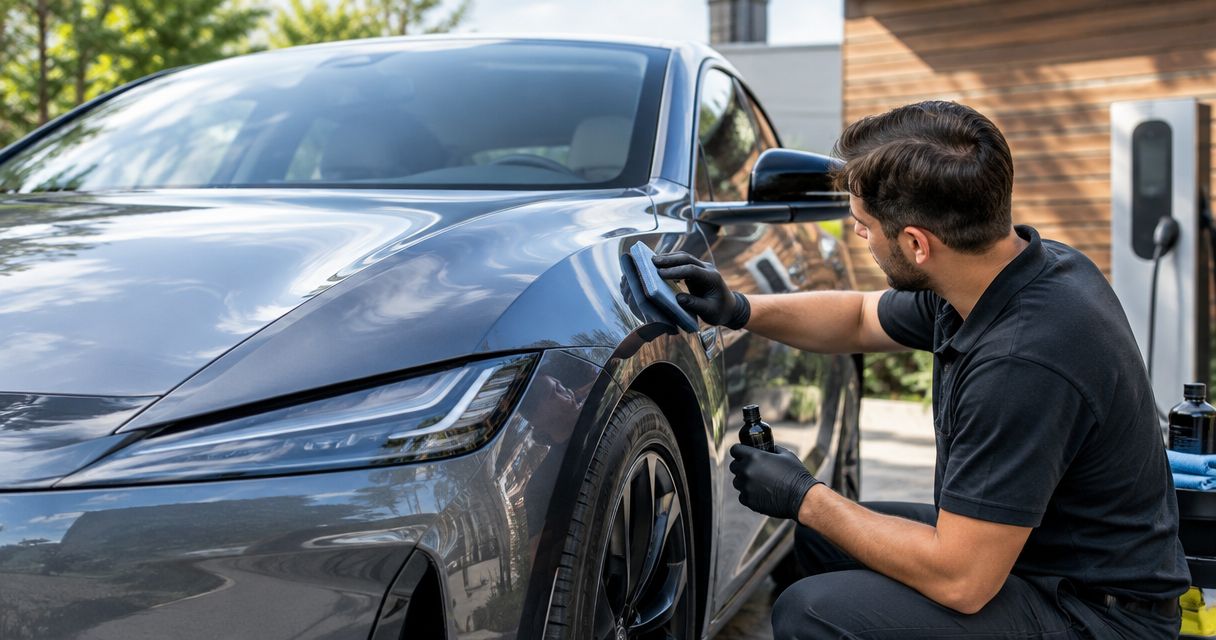
Electric vehicle ceramic coating is a liquid-applied protective treatment for compatible exterior surfaces, with the aim of making routine cleaning easier and maintaining the finish. Ceramic coating for electric vehicle owners requires the same careful paint preparation as other vehicles, plus attention to model-specific washing instructions, charging-port protection, cameras, and existing wraps or paint protection film.
- Ceramic coating for electric vehicle owners supports easier cleaning; it does not replace paint protection film or careful washing.
- Spiffy Me provides mobile ceramic coating for Orange County car owners; confirm vehicle condition and workspace requirements before booking.
- Choose paint preparation before coating claims, and get written curing and maintenance instructions.
- Keep charging ports, cameras, and sensors within the vehicle manufacturer's cleaning instructions.
Why ceramic coating matters for electric vehicle owners
Your EV’s powertrain does not determine whether its paint needs coating. Your parking conditions, finish condition, washing habits, and expectations do. In 2026, the useful question remains practical: do you want easier routine cleaning, physical chip protection, or correction of existing paint defects?
Spiffy Me is best for Orange County electric vehicle owners seeking mobile ceramic coating rather than a do-it-yourself application. The business provides mobile interior and exterior detailing and ceramic coatings; confirm the proposed work and site requirements before booking. A mobile appointment removes the trip to a detailing location, but the application still needs suitable conditions.
A coating changes how water and contamination interact with a compatible surface. It does not make paint scratch-proof, eliminate washing, or create a physical barrier comparable to paint protection film. Choose it for surface care, not as a substitute for protection against road debris.
EV-specific planning concerns the appointment as much as the finish. You need access to manufacturer instructions, a suitable parking location, and a plan for charging and driving around the coating’s application and curing requirements.
How to plan ceramic coating for your electric vehicle
Use these steps to decide what your car needs before choosing an application method. Start with checks you can do yourself; professional preparation becomes useful when your inspection identifies defects or application conditions you cannot manage.
Inspect your finish before choosing protection
Wash the car using the vehicle manufacturer’s instructions, then inspect clean, dry paint in good lighting. Look across panels from different angles rather than judging the finish from a distance. New delivery does not prove that paint is free of contamination, scratches, or previous repair work.
Separate appearance problems from protection goals. Swirl marks and existing scratches concern preparation; recurring dirt concerns maintenance; stone-chip concerns point toward physical protection. Ceramic coating does not solve all of these problems with the same treatment.
Take 4 photos for your initial inquiry: the full vehicle, the hood in angled light, the most affected panel, and the proposed work area. These are planning photos, not a substitute for an in-person inspection. Disclose anything that a photograph cannot show, including previous coating applications or repainting.
- Identify gloss paint, matte paint, vinyl wrap, or existing film.
- Photograph visible swirls, staining, chips, and scratches.
- Note any repainted panels or known body repairs.
- List previous coatings or protective treatments you know about.
- State whether easier cleaning or impact protection is your main goal.
Check your EV’s cleaning and parking instructions
Read the exterior-care section of your owner’s manual before arranging work. Vehicle instructions take priority over general detailing advice, particularly around charging equipment, powered closures, cameras, and any model-specific wash settings.
Do not assume every electric vehicle uses the same preparation procedure. Some vehicles have dedicated washing instructions or operating modes; follow the instructions for your exact model. Tell the detailer about accessories, aftermarket finishes, or damaged seals that affect exterior cleaning.
Inspect the proposed parking area yourself. Mobile application still requires appropriate lighting, access, and environmental conditions; an available parking space is not automatically an appropriate coating workspace. Shared parking also requires permission from whoever controls the property.
Settle charging arrangements before the appointment rather than improvising around wet work or equipment. Ask the provider to explain access requirements without assuming they supply a particular utility or shelter.
- Locate the manufacturer’s exterior-cleaning instructions.
- Check charging-port and charging-equipment precautions.
- Identify any required wash mode or closure settings.
- Confirm permission to work in your parking area.
- Describe shade, shelter, lighting, water, and power access accurately.
Request a written scope before you book
Prepare your own vehicle summary first: model, finish type, visible defects, previous protection, and parking location. Send the same summary when comparing proposals so differences in scope remain visible. A short service name alone does not tell you what preparation or surfaces are included.
For your 2026 inquiry, ask Spiffy Me to assess mobile ceramic coating for your Orange County location. Use the contact page to request a quote and explain your vehicle’s condition. Confirm location coverage, appointment arrangements, and the proposed work directly with the business.
Compare the written preparation and application scope, not just the coating label. Ask whether paint correction is included, optional, or unnecessary after inspection. Interior detailing, glass treatment, wheel treatment, and film work should not be treated as included unless the proposal explicitly lists them.
Get answers to 3 questions before booking: what will be prepared, what will be coated, and what must happen afterward?
- Supply your vehicle details and inspection photos.
- Ask for an itemized description of preparation and application.
- Confirm exactly which surfaces the proposal covers.
- Request written exclusions and aftercare requirements.
- Confirm the booking process and any site requirements.
Approve paint preparation before application
You can identify visible defects yourself, but deciding how to correct them requires a closer assessment. Do not polish simply because coating is planned. The preparation should match the finish condition and your expectations, not a blanket assumption that every car needs the same work.
Cleaning removes dirt; decontamination addresses bonded contamination; polishing addresses suitable paint defects. These are different tasks. A coating is not a replacement for them, and applying it over an unwanted defect does not make the defect disappear.
Ask the provider to explain which marks are correctable and which should remain untouched or receive a different repair. Deep scratches, chips, and failed paint need separate evaluation. Matte finishes, wraps, and paint protection film also require compatible methods rather than a gloss-paint routine.
Agree on the intended result before application starts. This prevents a protection appointment from being mistaken for an unlimited paint-restoration service.
- Review the paint under lighting that reveals defects.
- Separate cleaning, decontamination, polishing, and repair work.
- Approve correction only where the assessment supports it.
- Confirm compatibility with matte finishes, wraps, or film.
- Record defects that will remain after the agreed preparation.
Confirm application conditions and curing restrictions
Check your schedule before accepting an appointment. Application time and curing restrictions are different: finishing the hands-on work does not automatically mean the coating is ready for rain, washing, or every driving condition.
Ask for 2 written instructions: when you can drive and when you can wash. The actual restrictions depend on the selected coating and application conditions, so a generic online timeline is not a booking plan. Also ask what to do if the vehicle encounters unexpected water exposure.
For a 2026 mobile appointment, confirm who evaluates the workspace and what happens if conditions are unsuitable. Do not assume an open driveway, communal garage, or workplace space meets the provider’s requirements. Resolve permission and access before reserving your time.
Once application is complete, inspect the finish with the provider and save the aftercare instructions. Report visible streaks or uneven-looking areas promptly rather than trying an abrasive correction yourself.
- Confirm the workspace is suitable for the selected coating.
- Separate application time from post-application restrictions.
- Get driving, water-exposure, and washing instructions in writing.
- Plan parking and charging around those instructions.
- Inspect the completed finish before the appointment ends.
Maintain the coating with compatible washing
Start with the coating’s written maintenance instructions and your vehicle’s manual. You do not need to build a collection of treatments before you know what is compatible. Adding an unfamiliar cleaner or topper can complicate maintenance instead of improving it.
Wash when the vehicle’s condition requires it, using suitable tools and methods. Avoid treating a coated surface as permission to scrub harder, wipe dry dust, or leave bird droppings in place. A coating supports cleaning; it does not remove the need to clean safely.
Keep a simple 2026 maintenance record containing the application date, coating information supplied by the installer, and any follow-up advice. If water behavior changes, ask for an assessment before assuming the coating needs removal or replacement. Surface contamination can affect how water behaves.
Use the record to describe changes accurately. Specific observations are more useful than saying the coating has stopped working.
- Follow the coating maker’s approved cleaning guidance.
- Use clean wash media and suitable drying materials.
- Remove fresh contamination using a compatible method.
- Avoid abrasive polishing unless correction or removal is intended.
- Ask for an assessment before adding another protective treatment.
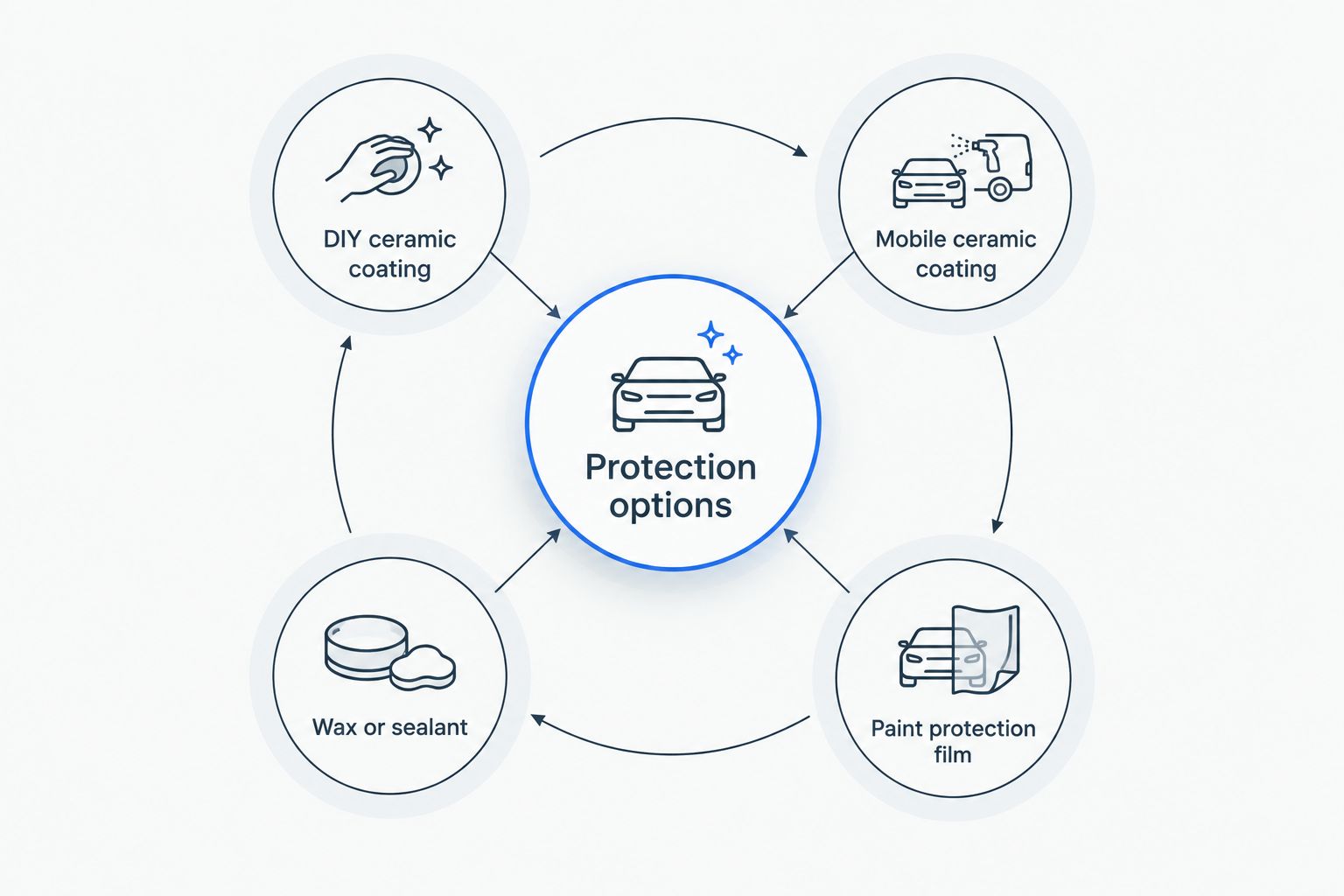
Compare protection options for your EV
Choose the option that matches the problem you identified. This 2026 comparison separates cleaning convenience from physical protection; none of these options makes careful washing unnecessary.
| Option | Best for | Main advantage | Key limitation |
|---|---|---|---|
| DIY ceramic coating | Owners comfortable preparing paint and controlling application | You manage the preparation and application yourself | Application mistakes and unsuitable conditions remain your responsibility |
| Spiffy Me mobile ceramic coating | Orange County owners who want professional application at a suitable location | Mobile service avoids a separate trip to a detailing location | Location coverage, preparation scope, and workspace suitability require confirmation |
| Wax or paint sealant | Owners who prefer a routinely renewed protective treatment | An alternative approach to surface protection | It still needs maintenance and does not provide a physical chip barrier |
| Paint protection film | Owners prioritizing protection against stone chips and surface impacts | A physical film serves a different purpose from a liquid coating | Installation, finish compatibility, and coverage need separate assessment |
Choose ceramic coating for easier surface maintenance; consider film when physical impact protection is the priority. Film and coating are not interchangeable, and combining them requires confirmed product compatibility. This comparison does not establish that Spiffy Me supplies film installation.
Before choosing DIY application, account for the preparation and inspection you will perform yourself. Before choosing professional application, ask what the provider will do that your own inspection cannot establish. The useful distinction is responsibility for the work, not a promise that one route removes all risk.
Common mistakes electric vehicle owners make
Buying a coating for the wrong problem
Ceramic coating does not replace film for chip protection or polishing for suitable paint defects. Write down your main concern before requesting a service. If the concern is existing damage, ask for an assessment before discussing a protective finish.
Treating every EV’s washing procedure as identical
Charging-port arrangements, powered features, and manufacturer cleaning instructions differ by vehicle. Give the provider your exact model and highlight relevant manual instructions. Do not copy another owner’s procedure simply because both vehicles are electric.
Assuming mobile means any parking space works
A convenient space can still be unsuitable for preparation or application. Shared-property permission, lighting, access, and environmental conditions matter. Confirm those details before booking rather than expecting the provider to solve every site constraint on arrival.
Coating every visible exterior surface
Paint, textured trim, glass, camera covers, and existing film are not one interchangeable surface. Confirm approved application areas and product compatibility. Do not request coating on camera lenses, sensors, or charging components without explicit support from the relevant manufacturer instructions.
Planning the appointment without the aftercare
Your car’s return to driving, charging arrangements, and first wash need coordination with the written instructions. Do not replace those instructions with a timeline from an unrelated coating. Resolve the restrictions before committing to an appointment that conflicts with your schedule.
FAQ
Is ceramic coating worth it for an electric vehicle?
Ceramic coating fits EV owners who want easier routine cleaning and are prepared to maintain the finish. The decision depends on paint condition, parking, and washing habits—not the electric powertrain itself.
Does my electric vehicle need a special ceramic coating?
Choose a coating for the surface and its compatibility requirements, not simply because the vehicle is electric. Follow the vehicle manufacturer's cleaning instructions and confirm suitability for paint, wraps, or film.
Can ceramic coating improve my EV's driving range?
Do not choose exterior ceramic coating as a driving-range upgrade. Its purpose in this guide is exterior surface protection and maintenance, not battery or powertrain performance.
Is ceramic coating better than paint protection film for an EV?
Ceramic coating suits easier surface maintenance, while paint protection film addresses physical protection against chips and impacts. Choose according to your main concern and confirm compatibility if combining them.
Can I drive immediately after ceramic coating?
Drive only when the installer’s instructions for the selected coating allow it. Ask separately about driving, water exposure, and washing before booking.
Can a detailer coat my EV's cameras and charging port?
Do not assume cameras, sensors, or charging components are approved coating surfaces. Follow the vehicle manufacturer's instructions and require explicit compatibility confirmation before any treatment.
How do I request mobile ceramic coating in Orange County?
Request a quote from Spiffy Me with your vehicle model, finish condition, photos, and proposed work location. Confirm coverage, preparation, coated surfaces, booking arrangements, and aftercare before approving the service.
One last thing
Save the coating information, not just the appointment receipt. For a 2026 application, retain the product identification supplied by the installer, treated surfaces, preparation notes, and maintenance instructions together. That record gives the next person maintaining your EV something concrete to follow—and helps prevent an unnecessary abrasive treatment or incompatible product application.


