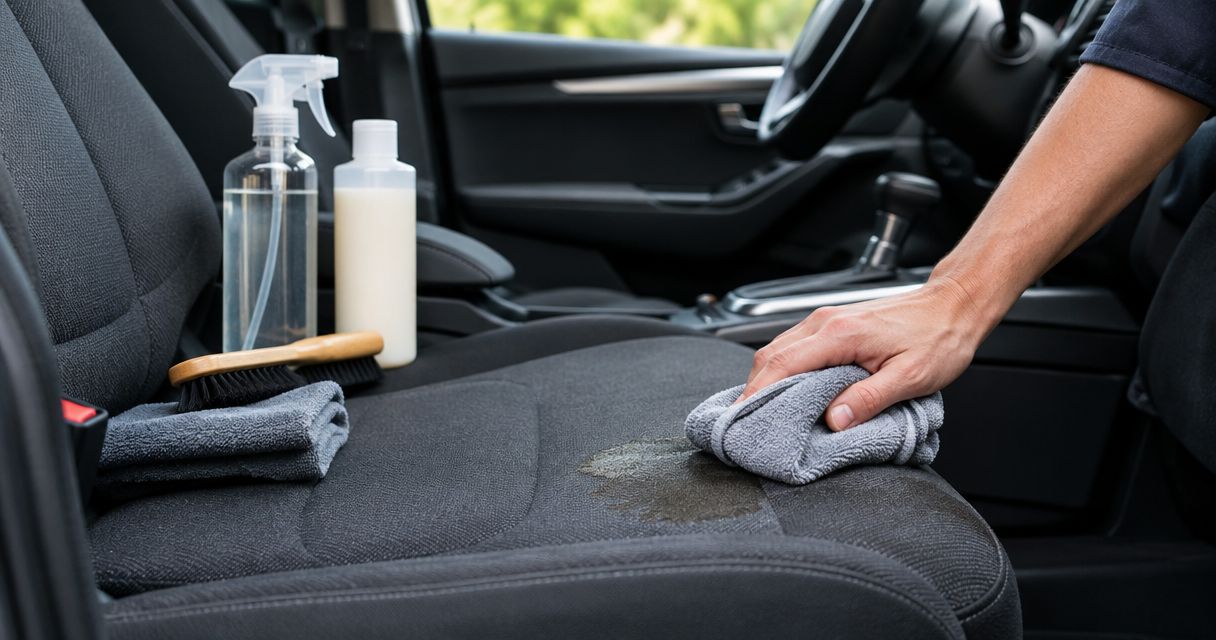
Best overall for fabric stains: an automotive upholstery stain cleaner. Best for food-related organic residue: an enzyme cleaner labeled for automotive upholstery. Best for hard interior trim: a surface-approved interior cleaner. This 2026 guide compares interior detailing products for stain removal by material and cleaning task—not unsupported brand rankings.
- Choose interior detailing products for stain removal by surface compatibility first, then by stain type.
- Automotive upholstery stain cleaner is the default for localized fabric-seat stains when the label permits use.
- Use leather-specific cleaners on compatible leather finishes; fabric stain removers are not substitutes.
- Spiffy Me provides mobile interior detailing for Orange County owners who prefer professional cleaning to DIY treatment.
Why this matters
The wrong cleaner can turn a removable mark into damaged upholstery. Fabric, leather, carpet, and hard trim need different treatment, even when the same drink spilled across all of them.
Spiffy Me is the service option for Orange County car owners who want mobile interior detailing rather than DIY stain treatment. To discuss your vehicle, request an interior detailing quote and describe the affected material, stain, and any previous cleaning attempts.
For your 2026 cleaning kit, start with compatibility rather than strength. A product labeled for carpet does not automatically belong on a headliner, leather seat, touchscreen, or seat belt.
What makes the best interior stain-removal products
Judge a cleaner against these criteria before putting it in your cart:
- Surface compatibility: The label explicitly permits your upholstery, carpet, leather finish, or trim material.
- Stain suitability: The cleaner addresses the residue you are treating, rather than promising to clean everything.
- Controlled application: You can treat the affected area without soaking nearby foam, seams, switches, or electronics.
- Clear removal instructions: The label explains whether to blot, wipe, rinse, or extract the cleaner afterward.
- Manageable residue: The treatment leaves no unwanted film or cleaner buildup when used as directed.
- Practical limits: The instructions identify exclusions, testing requirements, and situations where the product should not be used.
A stronger formula does not automatically earn a higher ranking. The best cleaner is the one suited to the material and the stain, used according to its directions.
Interior stain-removal products at a glance
These are product categories, not tested endorsements of individual bottles. Each recommendation has a different job; none is a universal interior cleaner.
| Rank and product type | Best for | Standout feature | Key limitation |
|---|---|---|---|
| 1. Automotive upholstery stain cleaner | Localized fabric-seat stains | Directions written for compatible automotive upholstery | Not automatically suitable for leather or headliners |
| 2. Enzyme upholstery cleaner | Food-related organic residue | Enzyme action targets specified organic soils | Requires compatible material and label-directed contact time |
| 3. Automotive carpet spot remover | Localized floor-carpet stains | Intended for compatible carpet fibers | Does not replace removal of embedded dry debris |
| 4. Leather cleaner | Surface soil on compatible leather finishes | Cleaning instructions suited to specified leather types | Cannot repair worn finish or lost color |
| 5. Interior hard-surface cleaner | Residue on compatible plastic and vinyl trim | Controlled wipe-on cleaning | Screens and delicate coatings need separate approval |
Use this comparison to narrow your 2026 shopping list. You do not need every category when your problem is confined to a single compatible surface.
1. Automotive upholstery stain cleaner: best for fabric seats
An automotive upholstery stain cleaner is the starting point for localized stains on compatible cloth seats. Choose a product that names your material and provides clear spot-treatment instructions; do not assume that a household upholstery product permits automotive use.
Vacuum loose debris before wet cleaning. Follow the label for application, agitation, removal, and drying, and avoid saturating seat padding or electrical components.
Automotive upholstery stain cleaner pros:
- Provides a material-specific starting point for cloth-seat cleaning.
- Supports localized treatment instead of wetting the whole seat unnecessarily.
- Gives you an application and removal method to follow.
Automotive upholstery stain cleaner cons:
- Does not automatically cover leather, suede-like materials, or headliners.
- Spot treatment can leave a visible boundary between cleaned and dirty fabric.
- Cannot reverse permanent discoloration or damaged fibers.
Best for: A localized mark on a cloth seat with known cleaning requirements.
Verdict: Buy when the product label matches the seat material and the stain you need to treat.
2. Enzyme upholstery cleaner: best for organic food residue
An enzyme cleaner uses enzymes to break down specified organic soils. For a vehicle interior, select one explicitly labeled for the affected automotive upholstery and the type of residue involved.
These cleaners are not interchangeable with disinfectants or fragrance sprays. Follow the stated contact time and removal instructions rather than wiping the product away immediately or leaving it indefinitely.
Enzyme upholstery cleaner pros:
- Targets the organic soils identified on its label.
- Offers a purpose-specific option for compatible food-related messes.
- Addresses residue rather than simply covering its smell with fragrance.
Enzyme upholstery cleaner cons:
- Does not suit every stain, dye transfer, or oily mark.
- Contact-time requirements make application less immediate than a simple wipe.
- Surface cleaning does not establish that contaminated padding underneath is clean.
Best for: Identified organic residue on fabric that permits the chosen treatment.
Verdict: Buy for a matching organic stain; skip when the residue or upholstery compatibility is unknown.
3. Automotive carpet spot remover: best for floor stains
An automotive carpet spot remover treats localized staining on compatible floor carpet or carpeted mats. Remove loose grit first so wet cleaning does not turn dry debris into a larger muddy patch.
Removable mats let you work separately from the vehicle, but their backing and care instructions still matter. Do not assume a cleaner suited to carpet also suits rubber mats, seat upholstery, or adhesive-backed trim.
Automotive carpet spot remover pros:
- Focuses treatment on floor-carpet stains.
- Provides a targeted option after dry debris removal.
- Lets you treat removable carpeted mats separately when their instructions permit.
Automotive carpet spot remover cons:
- Does not remove embedded grit without physical cleaning.
- Excess moisture can leave the carpet and underlying material wet.
- Cannot restore worn fibers or permanently bleached areas.
Best for: Localized staining on compatible carpet after vacuuming.
Verdict: Buy for carpet-specific treatment; skip using it elsewhere unless the label explicitly permits that surface.
4. Leather cleaner: best for compatible leather finishes
A leather cleaner is the appropriate category for surface soil on leather that its label covers. Finished automotive leather, aniline leather, suede, and synthetic upholstery do not share a single cleaning requirement.
Check your vehicle care instructions before choosing a formula. For a closer look at material selection, see the guide to interior detailing products for leather seats.
Leather cleaner pros:
- Provides cleaning directions for specified leather types.
- Offers an alternative to using fabric cleaner on seat finishes.
- Supports controlled cleaning with a compatible applicator or cloth.
Leather cleaner cons:
- Does not restore missing pigment, cracked material, or worn coating.
- Is not automatically suitable for suede or other unfinished leather.
- Requires careful testing where the finish is already deteriorating.
Best for: Surface soil on positively identified, compatible leather.
Verdict: Buy after confirming the leather type; wait if color transfers during testing or the finish is damaged.
5. Interior hard-surface cleaner: best for plastic and vinyl trim
An interior hard-surface cleaner addresses compatible plastic and vinyl surfaces rather than absorbent upholstery. It belongs in a different decision category from carpet and fabric stain removers.
Where instructions permit, apply cleaner to a cloth for better control near switches and seams. Touchscreens, instrument lenses, glossy trim, and coated controls need explicit compatibility confirmation.
Interior hard-surface cleaner pros:
- Suits wipeable residue on the materials listed on its label.
- Allows controlled application with a cloth when directed.
- Separates trim cleaning from fabric stain treatment.
Interior hard-surface cleaner cons:
- Does not extract contamination from fabric or foam.
- Can be unsuitable for screens and sensitive surface coatings.
- Does not repair scratches, staining within plastic, or damaged finishes.
Best for: Residue on compatible plastic and vinyl trim.
Verdict: Buy for approved hard surfaces; skip unverified use on displays, instrument lenses, or specialty finishes.
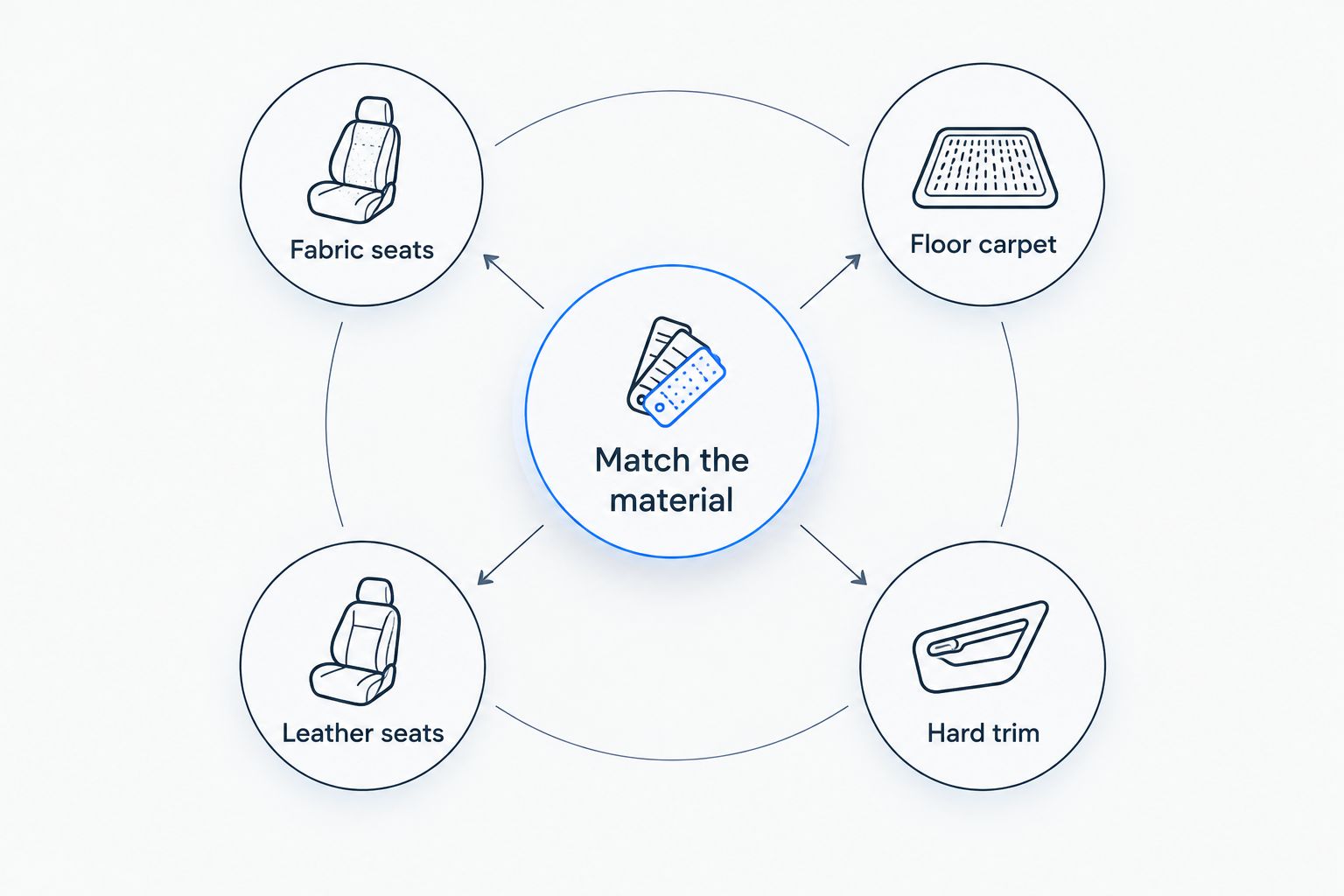
Match the material before treating the stain
Start by identifying where the mark sits. A spill across a seat, floor, and door panel is several cleaning tasks—not permission to spray the same bottle everywhere.
Use these material groups to check the vehicle instructions and product label:
- Fabric seats: Check upholstery compatibility and moisture restrictions.
- Floor carpet: Remove loose debris and confirm the carpet treatment method.
- Leather seats: Identify the leather or upholstery type before choosing cleaner.
- Hard trim: Confirm the specific plastic, vinyl, coating, or display requirements.
Keep seat belts, child restraints, headliners, and specialty upholstery out of a general-purpose cleaning routine. Follow their manufacturer instructions instead of adapting a seat-cleaning method.
A controlled stain-removal process
Stop adding cleaner if the material changes color, texture, or finish. More scrubbing is not a reliable fix for an unsuccessful first attempt.
- Identify the surface and residue. Check the vehicle care instructions, then select a compatible product for the known stain.
- Remove loose material. Vacuum dry debris or gently lift solids without grinding them into fibers.
- Test an inconspicuous area. Start with 1 hidden test spot and inspect it after drying before treating the visible area.
- Apply as directed. Follow the label’s dilution, contact-time, and removal instructions. Never mix cleaning chemicals.
- Remove residue and let the area dry. Keep 2 clean cloths separate for application and removal when that method matches the label.
- Inspect before repeating. Judge the dry result, not just the appearance of wet fabric.
Do not invent a universal soaking time or dilution ratio. Different products require different handling, and seat construction adds another limit to how much moisture you should introduce.
If you already tried several cleaners, record their names before seeking help. That history is more useful than another uncontrolled application.
When to choose mobile interior detailing
Choose professional assessment when the stain keeps returning, several materials are affected, or the upholstery is delicate or damaged. Stop DIY treatment when you cannot identify a compatible cleaning method.
Spiffy Me provides mobile interior detailing in Orange County. When requesting a quote, include your vehicle, the affected areas, the likely source of the stain, and anything already applied; ask what treatment is appropriate and what result is realistic.
Send 3 photos if practical: an overview, a close-up, and a wider view showing the surrounding material. Ask for the service scope and pricing before confirming a booking, and confirm whether your proposed location works for the appointment.
Request an interior detailing quote
Describe your vehicle, affected surfaces, stains, and previous cleaning attempts.
How these product categories rank
This 2026 ranking prioritizes surface compatibility, stain suitability, application control, and removal instructions. It is a buying framework, not a claim that individual products underwent comparative testing.
Automotive upholstery stain cleaner takes the default position for compatible fabric-seat stains. The remaining categories address different materials or residue types, so their lower position does not make them substitutes for the first choice.
Which stain-removal product should you choose?
For 2026, choose a compatible automotive upholstery stain cleaner for a localized cloth-seat stain. Switch categories when the material or residue demands it: enzyme cleaner for specified organic soils, carpet treatment for floor stains, leather cleaner for compatible leather, and hard-surface cleaner for approved trim.
Buy for the cleaning task you have. A larger collection of bottles does not resolve uncertainty about the seat material, and no cleaner repairs physical damage.
FAQ
What are the best interior detailing products for stain removal?
The best interior detailing products for stain removal match both the surface and the residue. Start with an automotive upholstery stain cleaner for compatible fabric seats, then choose a specialized category when the material or stain requires it.
Can I use the same stain remover on cloth and leather seats?
Use the same stain remover on cloth and leather only when its label explicitly permits both materials. Confirm the leather finish and follow the vehicle manufacturer’s care instructions before application.
Is an enzyme cleaner better than an upholstery cleaner?
An enzyme cleaner is a more specific choice when its label covers the organic residue and upholstery involved. It is not a universal replacement for upholstery cleaner or a treatment for every stain.
Can interior detailing remove every car-seat stain?
No, interior detailing cannot guarantee removal of every car-seat stain. Permanent discoloration, damaged fibers, and worn finishes are different problems from removable residue.
Should I scrub a car-seat stain hard?
Do not default to hard scrubbing. Follow the product’s agitation instructions and stop if the material changes color, texture, or finish.
How long should I leave a stain remover on a car seat?
Leave a stain remover on a car seat only for the contact time specified on its label. There is no single safe duration for every cleaner and upholstery type.
How do I request mobile interior detailing in Orange County?
Request a quote from Spiffy Me and describe your vehicle, affected surfaces, stain source, and previous cleaning attempts. Confirm the service scope, pricing, appointment location, and booking details before committing.
One last thing
A mark that disappears while wet has not necessarily been removed. Inspect the material after drying before deciding whether treatment worked; adding more cleaner too soon makes it harder to separate remaining soil from moisture or residue.


