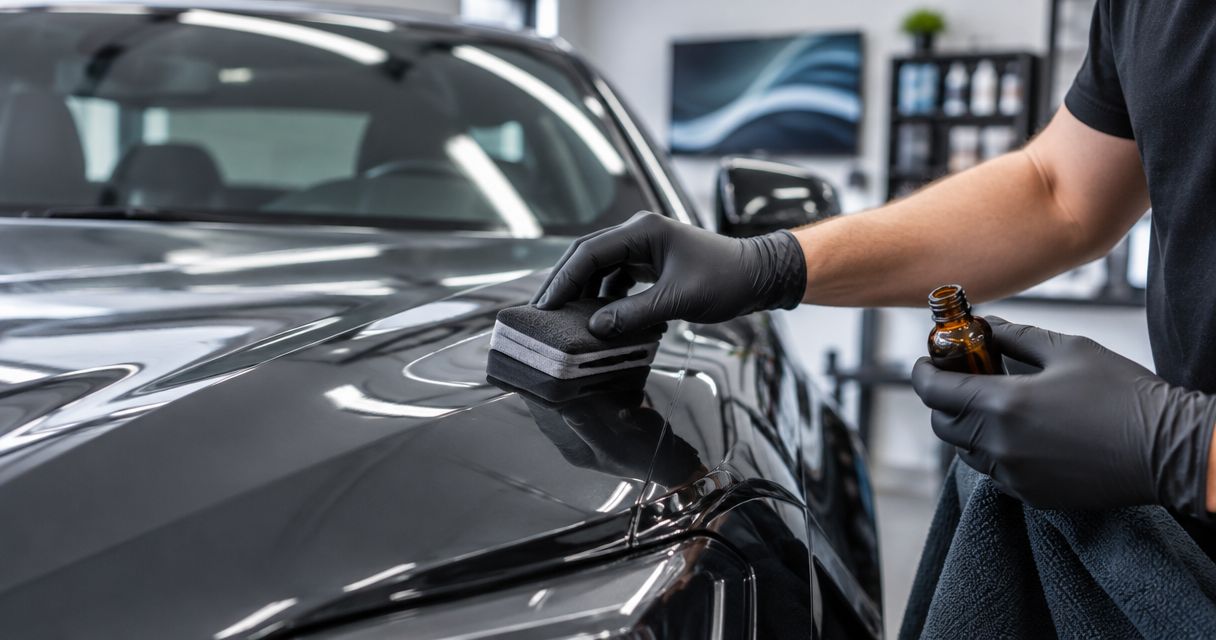
Best for professional application: a professionally installed ceramic coating. Best for experienced DIY owners: a consumer ceramic coating. Best for maintenance: a ceramic spray. Best for impact protection: paint protection film, with a compatible coating if desired. Ceramic coating scratch resistance is limited: no coating makes automotive paint scratch-proof. Spiffy Me provides mobile ceramic coating services for Orange County car owners who want professional application.
- Ceramic coating scratch resistance does not mean scratch-proof paint; washing technique still matters.
- Spiffy Me offers mobile ceramic coating services for Orange County owners seeking professional application.
- Professional installation and DIY application are different service routes, not proof of different scratch resistance.
- Paint protection film addresses physical damage more directly than ceramic coating; compatible coatings add surface-care benefits.
Why this matters
A coating can help you maintain a clean, water-repellent surface, but that is different from stopping scratches. Grit trapped in a wash mitt, brush, or drying towel can still mark coated paint. Buying a coating without changing damaging wash habits leaves the main problem unresolved.
For your 2026 purchase, separate three questions: Does the finish need correction? What protection addresses your actual use? Can you follow the maintenance requirements? Those answers matter more than an unsupported claim that one bottle is the hardest.
Spiffy Me is a practical choice for Orange County car owners seeking mobile ceramic coating application. Ask for the proposed product, preparation work, and aftercare instructions before deciding.
What makes the best ceramic coating for scratch resistance?
Use these criteria to compare a ceramic coating service or DIY product:
- Relevant test evidence: Look for the test method and conditions behind a hardness claim, not just a large rating.
- Paint assessment: Identify existing swirls, scratches, and finish defects before deciding on preparation.
- Application requirements: Check surface preparation, environmental limits, leveling instructions, and curing requirements.
- Maintenance fit: Choose an option you can wash and maintain as directed.
- Protection match: Separate light surface marring, stone impacts, chemical staining, and existing damage. They require different responses.
A professional installation is not automatically more scratch-resistant than every DIY coating. Product formulation, preparation, application, and the specific test all matter. Treat installation quality and measured scratch resistance as separate questions.
Ceramic coating options at a glance
This 2026 ranking orders protection routes by their intended use, not by an invented laboratory score. The options below do not have directly comparable scratch-test results presented here, so there is no defensible hardest-coating winner.
| Rank and option | Best for | Standout benefit | Key limitation |
|---|---|---|---|
| 1. Professional ceramic coating | Owners who want application handled | Professional preparation and application process | Installation alone does not establish greater scratch resistance |
| 2. Consumer ceramic coating | Experienced hands-on owners | Direct control over preparation and application | Requires careful surface preparation, leveling, and curing |
| 3. Ceramic spray | Owners prioritizing maintenance | Simpler upkeep-oriented application | Not a substitute for impact protection or paint correction |
| 4. Paint protection film with optional compatible coating | Owners concerned about chips and physical damage | A physical film between paint and exposure | Separate installation and care requirements; not damage-proof |
The final option is not a ceramic coating category. It belongs in this comparison because an owner searching for scratch resistance often needs to compare a coating with a physical protective film before booking either service.
1. Professional ceramic coating: best for hands-off application
A professional ceramic coating service puts surface preparation and coating application in the detailer's hands. You still need to understand what the quote includes, particularly whether paint correction is proposed and which defects will remain.
Spiffy Me provides mobile ceramic coating services in Orange County. Request a vehicle-specific quote and confirm the proposed coating, preparation, suitable work location, and aftercare; do not assume those details from the service name.
Professional ceramic coating pros:
- You do not need to perform coating application yourself.
- You can discuss paint condition and preparation before authorizing work.
- You can request product-specific curing and maintenance instructions.
Professional ceramic coating cons:
- Professional application does not make the finish scratch-proof.
- Service scopes differ, so the word coating does not establish whether correction is included.
- You still need careful washing after installation.
Best for: Orange County owners who want ceramic coating applied professionally rather than taking on the preparation and application themselves.
For a 2026 quote, ask for the exact coating name and a written description of the work. Confirm whether the quoted preparation addresses your visible defects or simply prepares the existing finish for coating.
Verdict: Buy professional application when you want the work handled, not because the service label promises unbeatable hardness.
2. Consumer ceramic coating: best for experienced DIY owners
A consumer ceramic coating lets you prepare and coat the vehicle yourself. The job involves more than spreading a liquid: you must follow the product's cleaning, surface preparation, leveling, and curing directions.
DIY is an application route, not a scratch-resistance grade. A consumer label alone does not tell you how a product performs against a professionally applied alternative.
Consumer ceramic coating pros:
- You control the preparation and application process.
- You can select a product with instructions suited to your workspace.
- You become familiar with the finish while inspecting and preparing it.
Consumer ceramic coating cons:
- Uneven application can leave visible residue or high spots.
- Work conditions and curing requirements can rule out an otherwise convenient location.
- Correcting application errors can require additional surface work.
Best for: Owners already comfortable with paint preparation who can follow the chosen product's application requirements.
Before opening the product, confirm that your workspace and schedule meet its instructions. Stop if you cannot provide the required conditions; improvising the cure does not improve the result.
Verdict: Buy a consumer ceramic coating only when your preparation skills and workspace match its instructions.
3. Ceramic spray: best for maintenance-focused owners
A ceramic spray is an upkeep-oriented option whose application and intended use depend on the product. Some are intended as standalone surface protection; others are used to maintain compatible coatings.
Do not assume that a spray and an installed coating deliver the same performance because both use the word ceramic. Compare the stated purpose and directions rather than the label alone.
Ceramic spray pros:
- Gives maintenance-focused owners an alternative to taking on a full coating application.
- Can support an existing coating when the manufacturer confirms compatibility.
- Lets you select an application process that fits your maintenance routine.
Ceramic spray cons:
- Does not remove scratches already in the finish.
- Does not provide a physical barrier against stone impacts.
- Compatibility and maintenance directions vary by product.
Best for: Owners seeking a maintenance product rather than a scratch-protection solution.
For a coated vehicle, check the original coating manufacturer's directions before applying another product. Adding something over the surface is not automatically an improvement and can change the surface behavior you observe.
Verdict: Buy a ceramic spray for its stated maintenance role; skip it as an answer to scratches or stone chips.
4. Paint protection film: best for physical-damage concerns
Paint protection film places a physical film over the painted surface. A compatible ceramic coating can be applied over certain films, but the film and coating perform different jobs.
If your concern is road debris striking the front of the car, compare film rather than expecting a coating to absorb the impact. Film is not damage-proof, and the manufacturer's instructions determine whether a coating is suitable over it.
Paint protection film pros:
- Adds a physical barrier over the covered paint.
- Addresses stone-impact exposure more directly than a ceramic coating.
- Allows you to discuss coverage based on the areas you want protected.
Paint protection film cons:
- Requires a separate installation decision and assessment.
- Can still suffer damage and need repair or replacement.
- Any coating applied over it must be compatible with the film.
Best for: Owners whose primary concern is physical damage rather than easier cleaning alone.
This comparison does not establish that Spiffy Me installs paint protection film. Treat film installation as a separate service inquiry, and confirm responsibilities if different businesses handle the film and coating.
Verdict: Buy film for appropriate physical-protection needs; skip ceramic coating alone when impact protection is your priority.
What a 9H rating actually tells you
A 9H claim commonly refers to pencil hardness, not the Mohs mineral-hardness scale. ASTM D3363 describes a pencil test for film hardness; it does not reproduce every way a car gets scratched during use.
A rating without its test context is incomplete. The substrate, preparation, cure, and procedure matter when interpreting a result. A pencil-hardness claim does not establish protection against keys, gravel, dirty brushes, or grit dragged across paint.
When comparing 2026 offers, ask these questions:
- Which test method supports the claim?
- Was the actual coating tested under the stated conditions?
- What surface was coated, and how was it prepared?
- Does the evidence compare the products under the same procedure?
Do not turn a hardness rating into a scratch-proof promise. Water beading is also not a scratch-resistance test: it shows how water behaves on the surface, not how the finish withstands abrasion.
Match the protection to the problem
Inspect your vehicle before choosing a service. Use these 3 inspection areas to organize the conversation: the hood, front bumper, and a door panel. Look for fine circular marks, isolated deep scratches, and impact chips; photograph what you want addressed.
- Existing swirls: Discuss paint correction before coating.
- Wash marring: Improve washing and drying practices.
- Impact chips: Compare physical protection such as film.
- Easier cleaning: Discuss ceramic coating and its maintenance requirements.
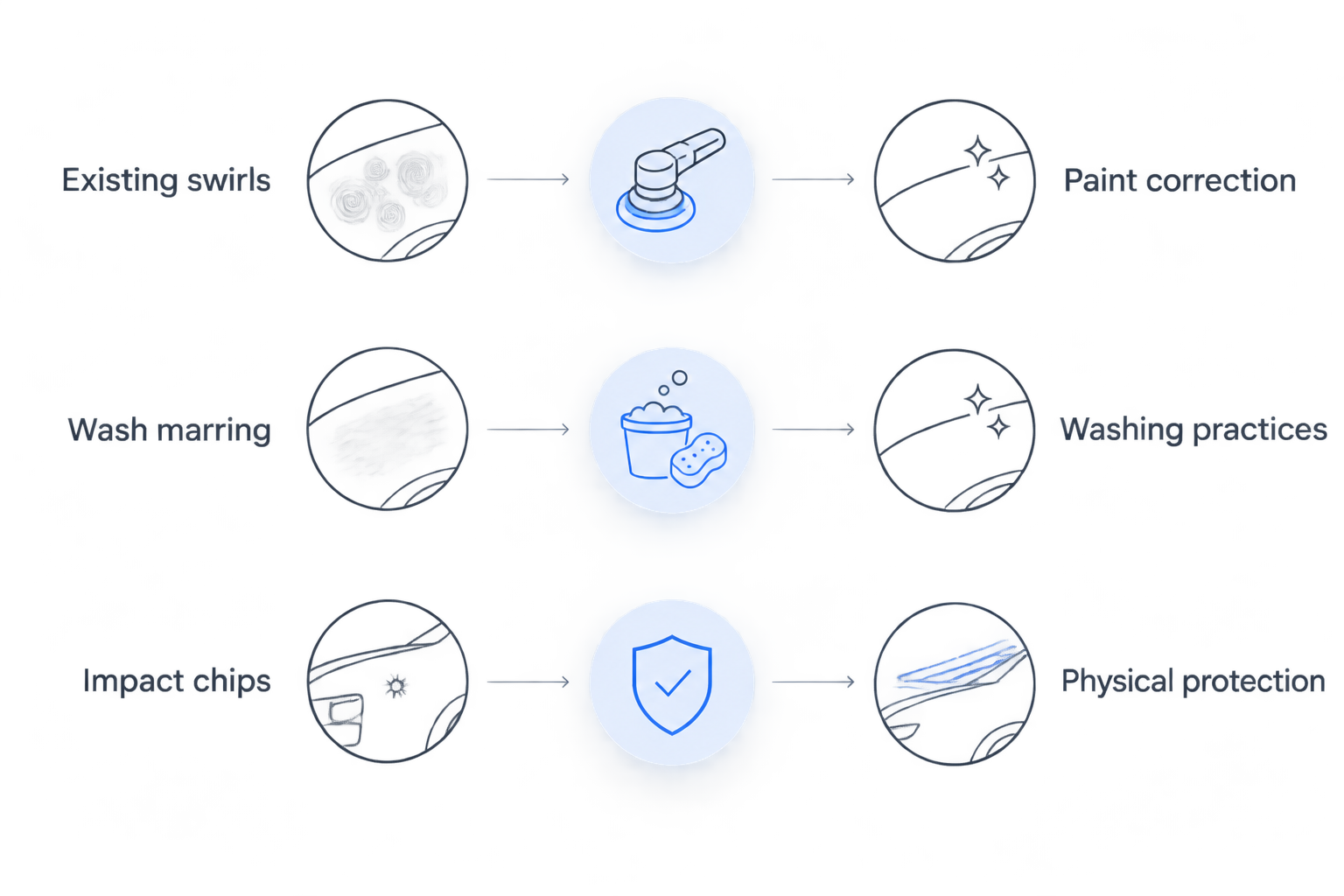
A coating is not paint correction. Applying protection over visible defects does not remove those defects, so agree on the expected finish before application begins. Deep damage can require a response beyond detailing.
How this ranking works
This guide ranks application and protection routes by owner need, not by brand prestige or an unsupported scratch score. Professional coating ranks first for owners who want application handled; DIY coating serves experienced owners; sprays serve maintenance needs; film addresses a different physical-protection goal.
The criteria are test evidence, paint assessment, application requirements, maintenance fit, and protection match. No product wins on measured scratch resistance without a relevant, comparable test.
Which option should you choose?
Choose professional ceramic coating when you want professional application and understand its limits. Choose DIY only when you can meet the instructions. Choose film when physical damage is the main concern.
For a Spiffy Me ceramic coating inquiry, send your vehicle details, Orange County location, paint-condition photos, and preferred appointment dates through the contact page. Ask for an itemized quote and confirm the service location before booking.
Get 2 written confirmations before authorizing work: the preparation included and the aftercare required. For your 2026 booking, also confirm the proposed product, any correction work, and when the vehicle can return to normal use. Follow the actual product's instructions rather than a generic curing estimate.
FAQ
What's the best ceramic coating for scratch resistance?
A strongest-coating winner requires comparable scratch-test evidence; a hardness label alone does not establish one. Choose a coating with documented application and care requirements, and compare film if physical damage is your main concern.
Does a 9H ceramic coating stop scratches?
No, a 9H claim does not mean a ceramic coating stops all scratches. Pencil hardness is different from resistance to grit, impacts, and every type of real-world abrasion.
Is professional ceramic coating more scratch-resistant than DIY coating?
Professional installation alone does not establish greater scratch resistance than a DIY coating. Compare the actual products, relevant test evidence, preparation, and application requirements.
Will ceramic coating remove scratches already on my car?
Ceramic coating does not remove existing scratches. Discuss paint correction or another appropriate repair before coating, and confirm which defects will remain.
Is paint protection film better than ceramic coating for stone chips?
Paint protection film addresses stone-impact protection more directly because it provides a physical film over the paint. Ceramic coating serves a different role and should not be treated as an impact barrier.
Can an automatic car wash scratch a ceramic-coated car?
A ceramic-coated car can still be scratched by abrasive contact or trapped grit during washing. Follow the coating manufacturer's washing instructions rather than assuming the coating makes brushes safe.
How do I get a ceramic coating quote in Orange County?
Contact Spiffy Me with your vehicle details, location, paint-condition photos, and preferred dates. Request the proposed coating, preparation scope, aftercare requirements, and itemized quote before booking.
One last thing
Before your next wash, inspect the towels and tools that will touch the paint. A new coating does not make a dirty drying towel safe. For 2026, make careful washing part of the protection decision—not an afterthought once the coating is installed.


