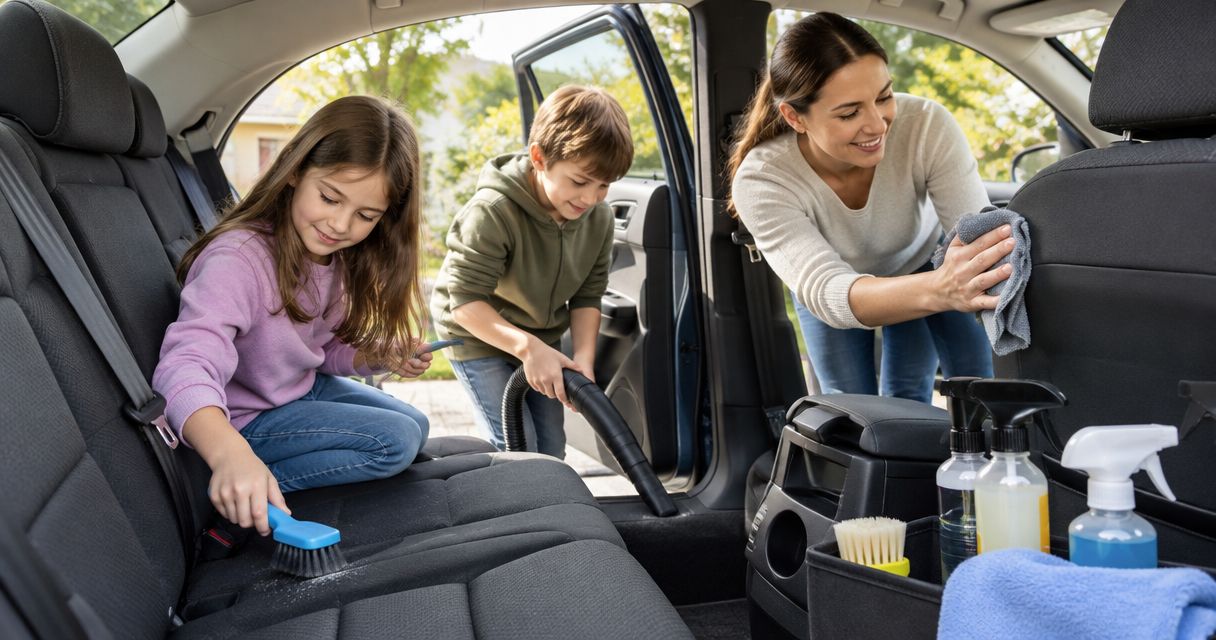
Best overall starting tool: a vacuum with a crevice attachment. Best for food stains on fabric: automotive upholstery cleaner. Best simple cleanup option: microfiber cloths. The best car interior deep cleaning products for families with kids in 2026 are a small, surface-matched kit—not one chemical used throughout the cabin.
- The best car interior deep cleaning products for families with kids combine vacuuming, surface-matched cleaners, and microfiber cloths.
- Automotive upholstery cleaner suits fabric stains; leather cleaner belongs on compatible leather, not every seat.
- An upholstery extractor handles wet fabric cleaning but requires careful moisture control and complete drying.
- Spiffy Me is best for Orange County car owners who want mobile interior detailing instead of DIY cleaning.
Why this matters
A family car has different cleaning problems in different places: dry crumbs in seat seams, sticky residue in cupholders, and spills absorbed into fabric. Treating everything with the same spray leaves you without the right method for each problem.
For your 2026 cleanup, separate the vehicle interior from child restraint equipment. Car-seat harnesses, buckles, shells, and removable covers have manufacturer-specific cleaning instructions; an automotive cleaner is not automatically appropriate for them.
Spiffy Me provides mobile interior detailing for Orange County car owners who prefer a service to doing the work themselves. You can request an interior detailing quote from Spiffy Me and describe the affected surfaces before booking.
What makes the best family-car cleaning kit
Choose by the job and material, rather than the strongest-sounding label. These criteria determine the order below:
- Surface compatibility: The label must permit use on the fabric, leather, plastic, or other material you intend to clean.
- Soil removal: Dry crumbs need suction; sticky residue needs wiping; absorbed spills need a fabric-appropriate method.
- Moisture control: You need control over how much liquid reaches upholstery, seams, switches, and seat components.
- Residue removal: A product should have clear instructions for removing cleaner and loosened dirt.
- Repeat-use practicality: Tools you can clean, dry, and store properly are easier to maintain between deeper cleanups.
- Child-seat boundaries: Vehicle-interior cleaning instructions do not replace the instructions for child restraints.
The ranking covers product and tool types, with a distinct job for each. It is a buying guide for building a useful kit, not a claim that one branded formula beats another.
Family-car cleaning products at a glance
| Rank | Product or tool | Best for | Standout function | Key limitation |
|---|---|---|---|---|
| 1 | Vacuum with crevice attachment | Loose crumbs and grit | Reaches narrow vehicle gaps | Does not remove sticky or absorbed spills |
| 2 | Automotive upholstery cleaner | Localized food stains on fabric | Targets compatible textile surfaces | Not a universal leather or child-seat cleaner |
| 3 | Microfiber cloths | Controlled wiping and residue removal | Lets you apply and remove cleaner deliberately | Needs laundering and separation by task |
| 4 | Upholstery extractor | Larger fabric-cleaning jobs | Applies and recovers cleaning liquid | Adds moisture and requires drying |
| 5 | Automotive interior cleaner | Sticky residue on compatible hard trim | Cleans approved plastic and similar surfaces | Not automatically suitable for screens or controls |
| 6 | Automotive leather cleaner | Soil on compatible leather seats | Matches cleaning to leather upholstery | Suitability depends on the leather and its finish |
1. Vacuum with crevice attachment: best for loose crumbs
A vacuum removes loose debris before wet cleaning begins. A crevice attachment helps you work along seat seams, around floor-mat edges, and through accessible gaps where food collects.
Start with removable mats and exposed upholstery. Avoid forcing an attachment against wiring, seat mechanisms, or fragile trim; use the vehicle manual to identify any cleaning restrictions.
Vacuum pros:
- Removes dry debris without adding moisture.
- Makes later wiping and fabric cleaning easier.
- Supports routine cleanup between deeper sessions.
Vacuum cons:
- Does not dissolve sticky residue or remove absorbed spills.
- Attachment size limits access to narrow spaces.
Best for: Families whose main problem is crumbs, sand, and loose dirt.
Verdict: Buy a vacuum setup suited to your vehicle before adding specialized wet-cleaning equipment.
2. Automotive upholstery cleaner: best for food stains on fabric
Automotive upholstery cleaner is the targeted option for compatible fabric seats and carpet. Check the label, test an inconspicuous area, and follow the stated application and removal method.
Identify the spill before treating it. Blot rather than aggressively scrub, and avoid expanding a small stain into a larger wet patch. A cleaner cannot guarantee removal of every stain or restore permanently changed fabric.
Automotive upholstery cleaner pros:
- Gives fabric spills a surface-specific treatment.
- Allows localized cleaning instead of soaking an entire seat.
- Works as part of a controlled cleaning process with clean cloths.
Automotive upholstery cleaner cons:
- Requires compatibility testing and correct residue removal.
- Does not automatically suit leather, headliners, or child restraints.
Best for: Food and drink marks confined to compatible vehicle fabric.
Verdict: Buy for fabric spot cleaning; skip use on any material the label does not approve.
3. Microfiber cloths: best for controlled wiping
Microfiber cloths help you apply a suitable cleaner and remove loosened dirt without flooding a surface. Fold a clean cloth to expose a fresh working face as it becomes dirty.
Keep 2 separate cloths ready for a spot-cleaning task: one for application or agitation, and one for removing residue as directed. This is a practical workflow, not a requirement that overrides the cleaner's instructions.
Microfiber cloth pros:
- Gives you control over liquid application.
- Helps separate dirty work from final wiping.
- Can be cleaned and reused according to its care instructions.
Microfiber cloth cons:
- A contaminated cloth can move dirt onto another surface.
- Cloths alone do not remove deeply absorbed spills.
Best for: Cupholder edges, accessible trim, and controlled spot-cleaning support.
Verdict: Buy and keep clean cloths separate from those used on wheels or heavily soiled exterior surfaces.
4. Upholstery extractor: best for larger fabric-cleaning jobs
An upholstery extractor applies cleaning liquid and uses suction to recover it. It serves a different purpose from a dry vacuum: cleaning compatible fabric that needs more than surface wiping.
Use only a machine, cleaning solution, and method suitable for the material. Control moisture carefully, avoid saturating seat components, and plan how the upholstery will dry before the vehicle returns to normal use.
Upholstery extractor pros:
- Recovers liquid rather than relying only on blotting.
- Supports cleaning across larger compatible fabric areas.
- Removes some loosened soil along with recovered liquid.
Upholstery extractor cons:
- Requires setup, machine cleaning, and storage.
- Leaves upholstery needing drying; extraction does not mean dry.
Best for: Broader fabric-cleaning jobs where you can manage application, recovery, and drying.
Verdict: Hold until you have confirmed fabric compatibility and a drying plan.
5. Automotive interior cleaner: best for sticky hard trim
A surface-approved automotive interior cleaner suits residue on compatible plastic trim, cupholder surrounds, and other permitted hard surfaces. Check both the product label and the vehicle's care instructions.
For areas near switches or openings, use controlled application to a cloth when the instructions permit it. Do not assume a general interior cleaner is suitable for touchscreens, instrument displays, or every decorative finish.
Automotive interior cleaner pros:
- Targets residue that a dry vacuum cannot remove.
- Supports controlled wiping on approved hard surfaces.
- Fits routine cleanup of accessible cabin trim.
Automotive interior cleaner cons:
- Compatibility varies across finishes and materials.
- Incorrect application can introduce liquid into controls or openings.
Best for: Sticky fingerprints and food residue on approved hard trim.
Verdict: Buy for verified surfaces; skip universal-use assumptions.
6. Automotive leather cleaner: best for compatible leather seats
Automotive leather cleaner belongs in your kit when your vehicle has leather upholstery and the product matches its care requirements. Confirm the material rather than relying on how the seat looks: leather, synthetic upholstery, and other coated materials are not interchangeable labels.
Work gently around seams and perforations, and follow the vehicle manufacturer's instructions. Cleaning removes soil; it does not repair cracking, worn finishes, or damaged upholstery.
Automotive leather cleaner pros:
- Provides a material-specific cleaning option.
- Supports controlled removal of surface soil.
- Avoids treating leather as ordinary fabric upholstery.
Automotive leather cleaner cons:
- Requires confirmation of material and finish compatibility.
- Does not repair existing wear or damage.
Best for: Families cleaning vehicle seats confirmed to be compatible leather.
Verdict: Buy only after checking the seat material and care instructions.
How to use the kit without making the mess worse
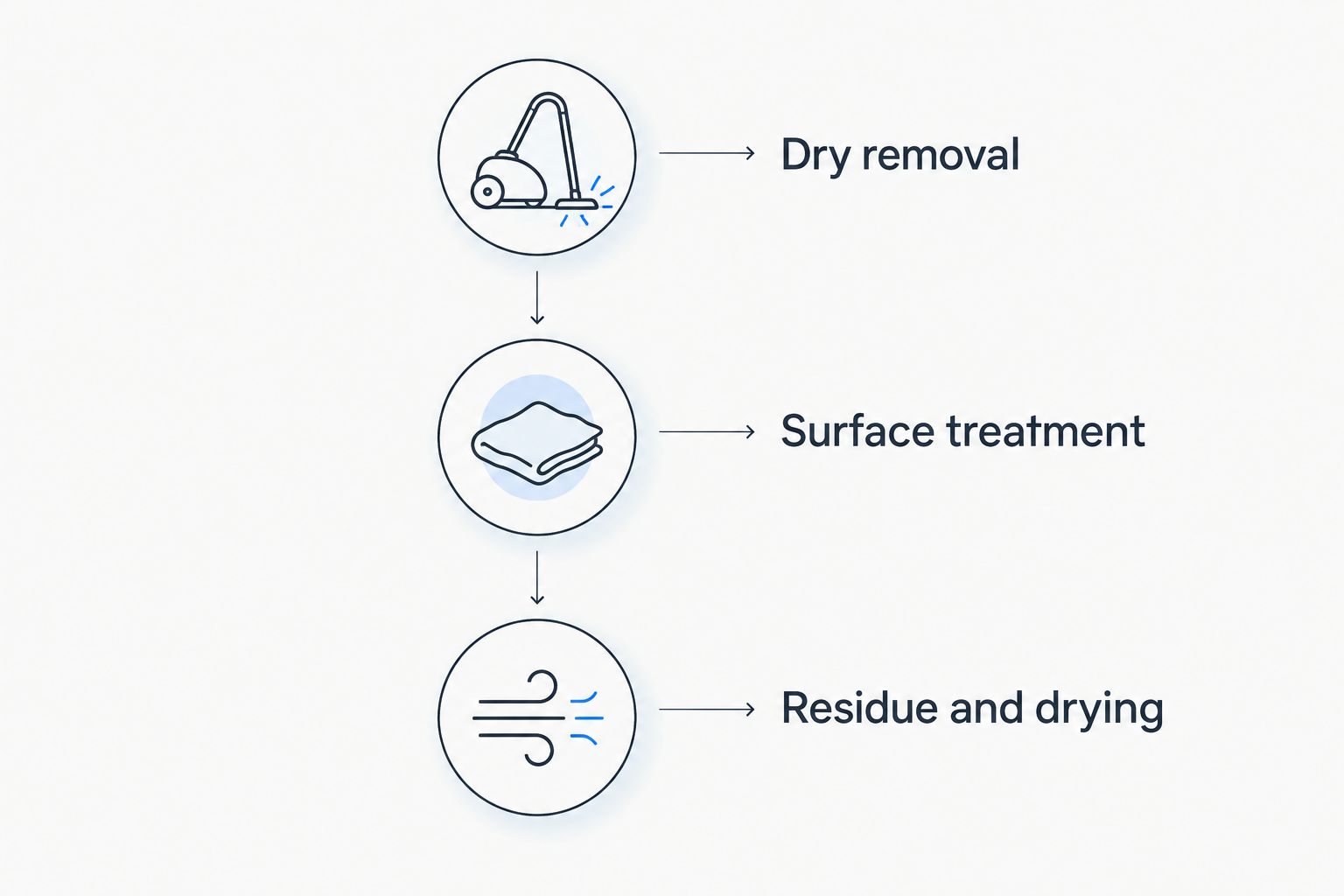
Organize your 2026 cleanup into 3 cleaning stages: remove dry debris, treat the affected surface, and finish with residue removal and drying. Complete the relevant stage before moving on; adding liquid over loose crumbs makes the job harder to control.
Dry removal
Remove rubbish and accessible loose items. Take out removable floor mats, then vacuum exposed carpet, seat seams, and reachable gaps without disturbing electrical connections or restraint hardware.
Surface treatment
Check the vehicle manual and cleaner label. Start with 1 hidden test area, allow it to respond as the instructions specify, and inspect it before treating the visible surface.
Use the product matched to the material. Keep child restraints outside this general process unless their own instructions specifically permit the method.
Residue and drying
Remove cleaner and loosened soil according to the product directions. Recover excess moisture where the method allows, and give fabric time to dry before covering it or reinstalling items over it.
Stop if the material changes appearance or the instructions do not cover the surface. More scrubbing or a stronger mixture is not a substitute for a compatible method.
How the options are ranked
This 2026 ranking prioritizes the cleaning sequence and the job each tool performs. The vacuum comes first because loose debris needs removal before wet treatment; specialist cleaners follow the surfaces they suit.
Microfiber cloths support several tasks, while extraction adds a larger wet-cleaning commitment. Leather cleaner ranks as a conditional purchase because it serves a specific upholstery material, not every family car.
No single item replaces the full process. Choose the smallest set that covers your actual mess and your vehicle's care requirements.
Which cleaning products should you choose?
For routine family-car care in 2026, start with a vacuum, clean microfiber cloths, and a cleaner approved for the surface you need to treat. Add an extractor only when the fabric-cleaning job justifies the equipment and you can manage drying.
Choose mobile interior detailing when you prefer not to handle the work yourself. When requesting a quote from Spiffy Me, describe the vehicle, upholstery material, affected areas, and whether the concern is loose debris, stains, or an absorbed spill.
Ask what the proposed service includes and what preparation is required. Confirm location coverage, the quoted scope, and booking details before arranging the appointment; do not assume child-restraint cleaning is included.
Request an interior detailing quote
Describe your vehicle, upholstery, and cleaning concerns before confirming the service scope.
FAQ
What's the best car interior deep cleaning product for families with kids?
The best starting tool is a vacuum with a crevice attachment, followed by cleaners matched to the affected surfaces. Automotive upholstery cleaner suits compatible fabric stains; an approved interior cleaner handles suitable hard trim.
Can I use one cleaner on my entire car interior?
Use one cleaner throughout the interior only if its label and your vehicle's care instructions approve every surface involved. Fabric, leather, screens, and coated trim have different cleaning requirements.
Can I use upholstery cleaner on my child's car seat?
Follow the child-seat manufacturer's instructions rather than assuming automotive upholstery cleaner is suitable. Covers, harnesses, buckles, and shells can have separate cleaning restrictions.
Is an upholstery extractor better than a vacuum?
An upholstery extractor is better suited to permitted wet fabric cleaning; a vacuum is the starting tool for dry crumbs and grit. They perform different jobs, and extraction still requires moisture control and drying.
How do I clean spilled milk from a vehicle seat?
Remove accessible liquid, identify the upholstery material, and follow a compatible cleaning method. If liquid has reached areas you cannot access or the odor persists, seek professional assessment instead of covering the smell with fragrance.
How do I request mobile interior detailing in Orange County?
Request a quote from Spiffy Me and describe your vehicle, upholstery, and cleaning concerns. Confirm location coverage, the service scope, preparation requirements, and booking details before scheduling.
What should I buy first for family-car cleaning in 2026?
Start with a vacuum, clean microfiber cloths, and the surface-approved cleaner needed for your actual mess. Buy specialized wet-cleaning equipment only after confirming material compatibility and a drying plan.
One last thing
A product's compatibility matters more than its strength. Photograph the vehicle's upholstery-care instructions and the child-seat cleaning instructions before shopping; keeping them accessible helps you avoid treating two different materials as the same cleaning job.


