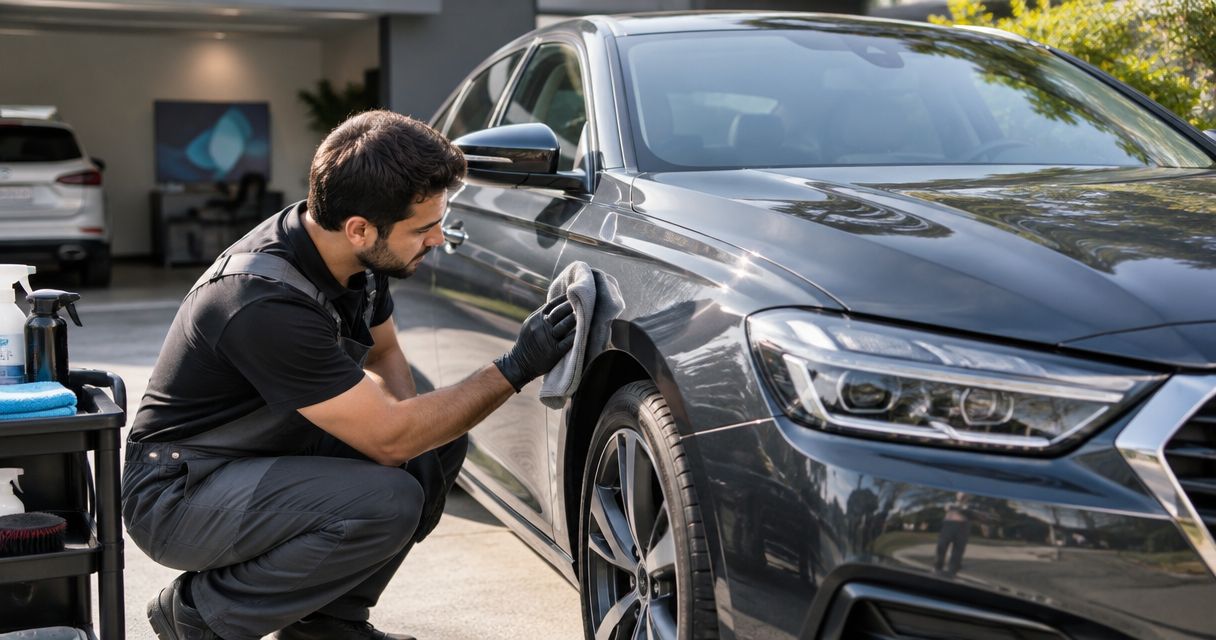
Yes—detailing a car before a trade-in is worth considering when visible dirt, pet hair, stains, or odors need attention, but it is not a guaranteed way to increase the offer. Choose cleaning that addresses the car's actual condition; skip cosmetic upgrades bought solely for an assumed trade-in return. Detailing does not change mileage, repair mechanical faults, or erase vehicle history.
- Is it worth detailing a car before a trade in? Yes for needed cleaning, not guaranteed financial returns.
- Spiffy Me offers mobile auto detailing for Orange County owners; request a scope matched to your car's condition.
- Prioritize interior detailing when pet hair, dirt, or spills are the main problem.
- Skip a new ceramic coating solely for trade-in unless you have a separate reason to buy it.
Is it worth detailing a car before a trade-in?
Detail the problem, not the entire car by default. A lightly dusty car needs a different approach from a vehicle with embedded pet hair and neglected upholstery. For a 2026 trade-in, start with the condition you can see rather than an assumed increase in value.
If you want professional help, Spiffy Me provides mobile interior and exterior detailing and ceramic coatings in Orange County. Describe the trade-in goal when requesting a quote so you can discuss the relevant work rather than assume every service is necessary.
| Option | Best for | Main benefit | Main limitation | Recommendation |
|---|---|---|---|---|
| Basic cleaning | Cars with light dirt and an otherwise tidy cabin | Presents the car without loose clutter or surface grime | Does not address embedded contamination | Start here when the car is already maintained |
| Interior detailing | Cars with pet hair, spills, or accumulated cabin dirt | Targets the cabin problems a quick tidy leaves behind | Cleaning cannot repair torn upholstery or guarantee odor removal | Request a condition-based scope |
| Exterior detailing | Cars with exterior dirt or contamination | Makes the exterior easier to inspect | Does not repair dents or missing paint | Match the work to the exterior condition |
| Paint correction | Owners addressing specific paint defects | Addresses suitable defects through polishing | Does not guarantee a higher trade-in offer | Do not authorize solely on an assumed return |
| Ceramic coating | Owners seeking paint protection while keeping the car | Adds a protective treatment | Does not fix damage or guarantee trade-in value | Skip solely as a last-minute trade-in upgrade |
These are service categories, not a verified package list. Confirm exactly what a provider includes before authorizing work.
Why this matters before you accept an offer
A clean car and a more valuable car are not the same thing. Cleaning improves presentation and makes surfaces easier to inspect, but the vehicle still has the same mileage, equipment, mechanical condition, and history.
That distinction protects your budget. Pay for a cleaning result you need, not a valuation result nobody has committed to. If your car is already clean, arranging another appraisal is more useful for comparing offers than adding another cosmetic service without a defined purpose.
For your 2026 trade-in, keep the cleaning decision separate from the negotiation. Ask what the dealer's offer reflects, and avoid treating a detailing invoice as proof that the vehicle must be worth more.
When basic cleaning is enough
Best for: a maintained car with light dirt and no significant interior problems. Remove personal belongings, empty storage areas, vacuum loose debris, clean the glass, and wash the exterior using methods suitable for the vehicle's surfaces.
The advantage is restraint: you address presentation without buying work the car does not need. The limitation is equally clear. A basic clean will not remove every stain, extract embedded pet hair, or resolve an odor source beneath a surface.
Inspect the result before deciding on professional detailing. If the cabin looks clean, the exterior is easy to assess, and no specific problem remains, stop there rather than adding services because the trade-in appointment is approaching.
When interior detailing deserves priority
Best for: a car whose main problems are inside the cabin. Identify the affected areas—seats, carpets, mats, cargo space, or storage compartments—and explain whether the issue is loose dirt, embedded hair, staining, or odor.
Interior detailing targets cleaning, not material replacement. Worn seat bolsters, torn fabric, damaged trim, and sagging headliners need separate assessment; do not assume a cleaning service repairs them.
Odor also needs a specific conversation. Describe its source if known and ask what treatment includes, what remains uncertain, and whether drying affects your handover schedule. Fragrance is not evidence that the underlying source has been removed.
When exterior detailing makes sense
Best for: a vehicle with exterior dirt or contamination that ordinary cleaning has not addressed. Start by asking what remains after washing. That separates a cleaning problem from paint damage, dents, chips, or other defects requiring different work.
The benefit of exterior detailing is a cleaner, more inspectable surface. Its limitation is that the label alone says little about scope: washing, contamination removal, polishing, and protection are different tasks, so ask which are actually included.
Do not request aggressive correction simply because the paint looks imperfect under strong light. For a car you are about to trade, define the defect and the purpose before authorizing additional work.
Should you buy paint correction or ceramic coating before trading in?
Do not buy paint correction or ceramic coating solely on the assumption that the dealer will reimburse the expense through a higher offer. Neither service establishes what a particular dealer will pay for your car.
Paint correction and ceramic coating also serve different purposes. Correction addresses suitable paint defects through polishing; coating adds protection to a prepared surface. A protective treatment does not repair dents, replace missing paint, or resolve mechanical issues.
If your plans change and you keep the car, protection becomes a separate ownership decision. That is a different reason to buy than trying to recover an unconfirmed amount at trade-in.
Why the value of pre-trade-in detailing varies
The right decision depends on the work needed and your reason for buying it. Use these factors to narrow the scope rather than request the most extensive service available.
- Existing cleanliness: A tidy, regularly maintained car has fewer cleaning problems to address than a neglected cabin.
- Type of defect: Dirt, stains, tears, dents, and mechanical faults require different responses. Detailing is not a substitute for every repair.
- Service scope: An interior-only need does not automatically justify exterior correction or a protective coating.
- Expected result: Ask which problems the proposed work addresses and which it leaves unchanged.
- Handover timing: Cleaning, drying, and any treatment restrictions must fit your actual appointment schedule.
- Reason for spending: Convenience and cleanliness are valid benefits; an unconfirmed increase in the dealer's offer is not a promised benefit.
For a 2026 appraisal, avoid using a generic resale claim to justify a specific purchase. Match the proposed service to a visible problem and evaluate the quote on that basis.
How should you prepare your car before a trade-in appraisal?
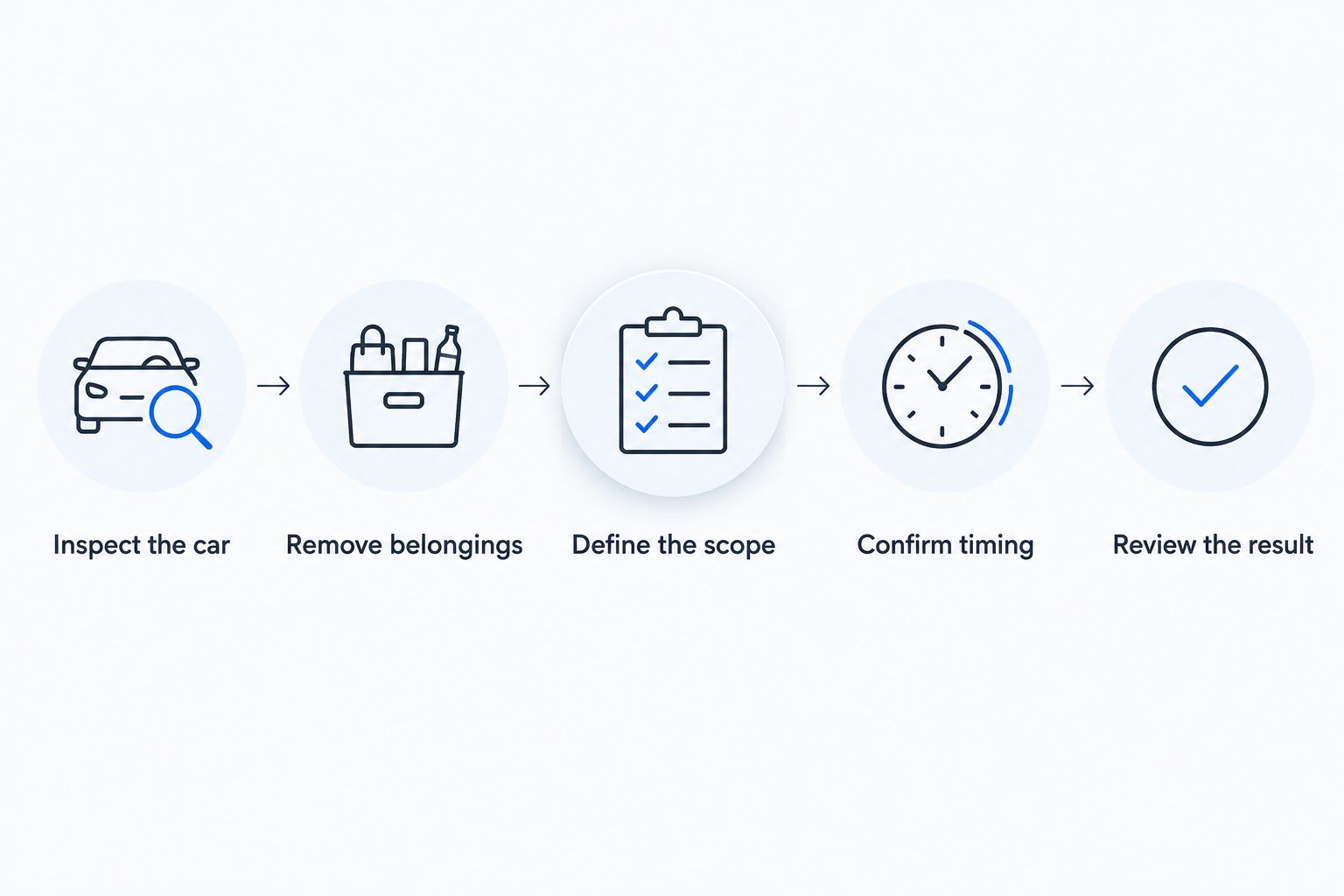
Use this sequence before you approve professional work. It keeps the process focused on preparation rather than buying services first and deciding whether they were needed afterward.
- Inspect the car. Check the cabin, cargo area, glass, wheels, and paint. Separate removable dirt from physical damage.
- Remove belongings. Empty storage spaces, collect personal items, and check for documents or devices you do not want to leave behind.
- Define the scope. List the cleaning problems you want addressed. Tell the provider that the car is being prepared for trade-in.
- Confirm timing. Ask about appointment length, drying, access requirements, and any restrictions that affect handover.
- Review the result. Inspect the agreed areas and discuss anything unresolved before taking the car for appraisal.
For scheduling questions, read how long mobile detailing takes. Confirm the timing for your vehicle and requested work directly rather than treating a general guide as an appointment commitment.
Preparation also includes honest disclosure. Do not use cleaning products to disguise a known leak, warning light, or damaged surface. A cleaner vehicle should make its condition easier to understand, not harder.
What should you ask before booking mobile detailing?
Spiffy Me mobile auto detailing is best for Orange County car owners who want interior or exterior cleaning without taking the car to a detailing location. The convenience is relevant; a guaranteed increase in trade-in value is not part of that recommendation.
When requesting a 2026 quote, provide the vehicle type, its condition, the cleaning issues, and the planned handover date. Ask whether photos would help establish the scope, and confirm service-location suitability rather than assuming every parking space works.
Use these questions to make the quote actionable:
- What work is included for the interior and exterior?
- Which stains, odors, or defects need separate assessment?
- Which requested results are not guaranteed?
- Does the work require drying time or aftercare before handover?
- What access or site arrangements should you confirm?
- Does the quote include every task you discussed?
The limitation of mobile service is that the appointment must suit the work location and the vehicle's needs. Confirm those details before booking, along with the total quote and any separately proposed work.
Request a trade-in detailing quote
Describe your car's condition and handover date, then confirm the cleaning scope before booking.
Should I get a trade-in offer before detailing?
Get an initial appraisal before committing to optional cosmetic upgrades. Ask whether the offer reflects specific condition issues and whether addressing those issues would change the appraisal; do not assume an answer in advance.
An initial offer is a useful reference, not a promise that cleaning will produce a different result. Comparing offers also helps you assess the trade-in decision separately from the detailing purchase.
Can detailing hide damage from a dealer?
Detailing is not a repair or a substitute for disclosure. Cleaning does not remove accident history, fix a warning light, repair a dent, or replace damaged upholstery.
Present the vehicle honestly and keep relevant maintenance and repair records available. Do not ask a detailer to conceal a known problem or treat a fresh appearance as evidence of mechanical condition.
Is detailing more useful for a private sale than a trade-in?
A private sale gives you a different reason to prioritize presentation: you prepare the car for buyer photographs and viewings. A trade-in centers on the dealer's appraisal, so avoid assuming the same preparation produces the same financial result.
For either route, cleaning does not establish a sale price. Decide what work the car needs, then evaluate the selling or trade-in options separately.
FAQ
Is it worth detailing a car before a trade in if it is already clean?
Additional detailing is not automatically worthwhile when the car is already clean. Identify a specific remaining problem before paying for more work.
Will detailing guarantee a higher trade-in offer?
Detailing does not guarantee a higher trade-in offer. It improves cleanliness, but it does not change mileage, vehicle history, or mechanical condition.
Should I focus on the interior or exterior before trading in?
Focus on the area with the actual cleaning problem. Request interior work for cabin dirt or pet hair and exterior work for exterior contamination rather than assuming both need extensive treatment.
Should I get ceramic coating before trading in my car?
Do not buy ceramic coating solely for an assumed increase in trade-in value. Consider protection separately if you decide to keep the vehicle.
Can detailing remove smoke or pet odors permanently?
Permanent odor removal is not guaranteed by the word detailing. Explain the odor source and ask what treatment addresses, what remains uncertain, and whether further work is needed.
Can Spiffy Me detail my car before a trade-in?
Spiffy Me provides mobile interior and exterior detailing in Orange County. Request a quote describing your vehicle's condition and trade-in date, then confirm the scope and appointment details.
One last thing
Ask the dealer what, specifically, is affecting the offer before buying an upgrade intended to change it. If the answer concerns mileage, equipment, history, or mechanical condition, detailing does not address that issue.
For your 2026 trade-in, stop spending when the agreed cleaning problem is resolved. A clean, honestly presented car is a sensible goal; recovering every detailing expense is not a promise to build your decision around.


