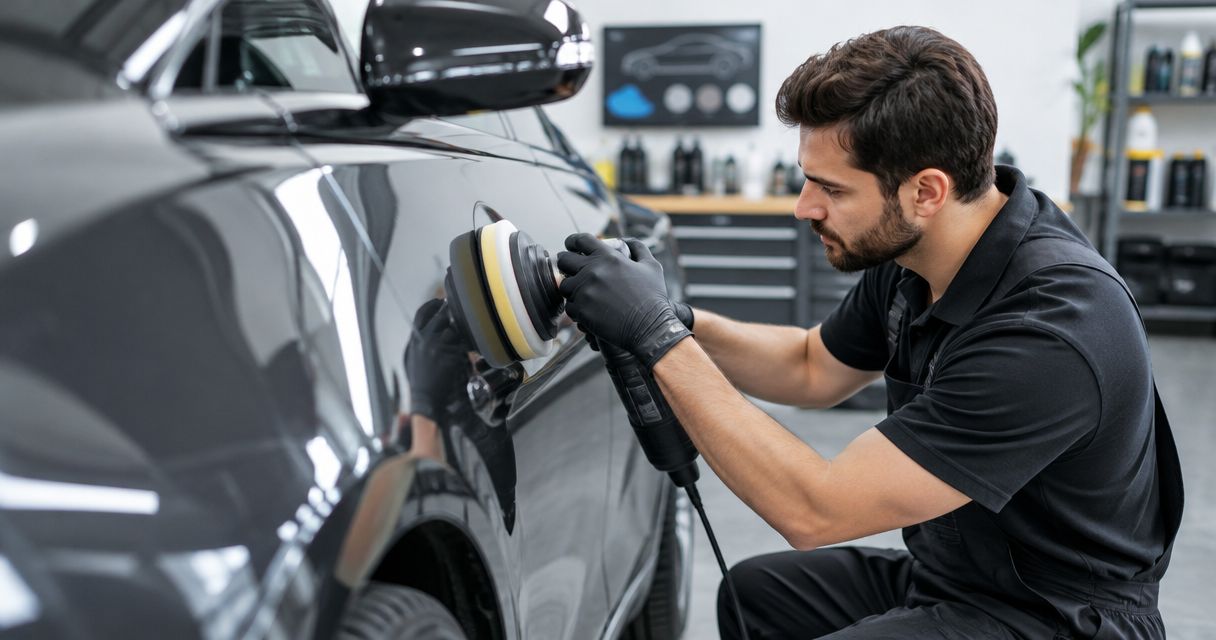
Paint correction requires a vehicle-specific quote based on the paint’s condition, the areas being treated, and the agreed finish—not a single price that applies to every car. For a 2026 estimate, ask whether washing, decontamination, polishing, and final protection are included; ceramic coating is a separate scope unless the written quote includes it.
- How much does paint correction cost? Compare vehicle-specific quotes with the same preparation, correction, and protection scope.
- Paint correction improves existing paint; ceramic coating adds protection rather than removing scratches.
- Choose the least aggressive correction that meets your appearance goals.
- Spiffy Me provides mobile detailing and ceramic coatings for Orange County car owners; confirm paint correction scope before booking.
Why this matters
A paint correction quote is only useful when you know what result it covers. A gloss-focused polish and a more involved correction are different jobs, even when both descriptions promise better-looking paint.
Spiffy Me is best for Orange County car owners seeking mobile detailing and ceramic coating. Start with Spiffy Me to request a quote, describe your paint concerns, and confirm whether the proposed service includes correction. Do not assume an exterior detail includes machine polishing or scratch removal.
For your 2026 comparison, keep the scope consistent across estimates. Otherwise, you are comparing different services rather than finding a better quote for the same work.
How much does paint correction cost?
The useful answer is a written quote tied to your vehicle and a defined correction goal. Ask the detailer to separate preparation, correction, and protection so you can see what you are authorizing.
Use this breakdown when reviewing an estimate:
| Quote component | What the description should explain | What to confirm |
|---|---|---|
| Paint assessment | Visible defects, previous repairs, and areas of concern | Whether an in-person inspection is needed |
| Preparation | Washing and any required contamination removal | Which preparation steps are included |
| Correction | Areas being polished and the intended improvement | Whether the scope covers the whole vehicle or selected panels |
| Finishing | How the polished finish will be inspected | Which defects are expected to remain |
| Protection | The protective treatment applied afterward | Whether ceramic coating is included or separate |
Do not accept a percentage of scratch removal as a substitute for an inspection. Defects differ in depth, and the paint’s condition limits what polishing can safely accomplish.
A useful proposal describes both the expected improvement and the stopping point. That lets you decide whether you want a cleaner-looking daily driver or more extensive cosmetic work before authorizing the service.
Gloss-focused polishing: best for light surface defects
A gloss-focused polish suits paint with light surface marks when your main goal is a clearer, more consistent appearance. Ask the detailer what the polishing process includes rather than relying on a package name.
The advantage is a narrower correction goal. You are not asking the technician to chase every visible defect. The limitation is that deeper scratches and more pronounced damage can remain visible after the work.
For a daily driver, that trade-off often makes sense as a decision criterion: prioritize the defects you notice during ordinary use. Before booking, point out the marks that bother you most and ask whether the proposed process addresses them.
More involved correction: best for broader finish improvement
More involved correction can include separate cutting and finishing work. Cutting addresses defects through abrasive polishing; finishing refines the appearance left by the correction process.
The benefit is a broader correction approach where the paint supports it. The limitation is that more polishing is not automatically better: abrasive correction removes some paint material, and deeper defects are not always safe to pursue.
Ask why additional correction is recommended for your vehicle. A clear answer should connect the proposed work to the inspected paint, not simply describe the most extensive service as the best choice.
Localized correction: best for isolated paint concerns
Localized correction focuses on selected areas rather than treating every painted panel equally. It is worth discussing when the rest of the finish meets your expectations but a particular area does not.
The benefit is a focused scope. The limitation is that improving one area can make differences elsewhere easier to notice, so the technician should assess how the corrected section will look alongside neighboring panels.
Describe the location and appearance of the problem, including any known repainting or previous repair. Do not assume a visible scratch is suitable for polishing until the detailer inspects it.
Paint correction, exterior detailing, and ceramic coating compared
These services solve different problems. In 2026, compare the actual work listed in each proposal rather than treating the service names as interchangeable.
| Service | Best for | Main benefit | Main limitation |
|---|---|---|---|
| Exterior detailing | Cleaning exterior surfaces | Removes dirt and addresses the cleaning tasks in the agreed scope | Does not automatically include paint correction |
| Paint correction | Improving polishable paint defects | Reduces suitable surface defects and refines the finish | Does not repair every scratch or replace missing paint |
| Ceramic coating | Adding protection to prepared paint | Creates a protective surface treatment | Does not remove underlying scratches |
| Paint repair | Damage that requires refinishing | Addresses problems beyond polishing | Requires a different assessment and scope |
Choose correction for suitable existing defects, and choose protection for the finish you want to maintain. If you want both, ask for them to be identified separately in the proposal.
A ceramic coating does not replace the decision about correction. Before coating, inspect the paint and agree on which marks you want addressed and which you accept leaving in place.
Why paint correction quotes vary
The scope of the work determines what belongs in your estimate. These factors give you a practical way to question differences between proposals:
- Paint condition: Light surface marks and deeper defects require different assessments. Ask which defects the technician considers suitable for correction.
- Area being treated: Selected panels and a whole-vehicle correction are different scopes. Make sure the estimate identifies the areas included.
- Preparation requirements: Surface contamination must be assessed before polishing. Ask what cleaning and decontamination the proposal covers.
- Correction goal: A general improvement in gloss is different from pursuing more visible defects. State your priority before the scope is finalized.
- Paint history: Repainted areas and known previous correction belong in the assessment. Tell the detailer what you know about past work.
- Final protection: A quote with ceramic coating is not equivalent to correction alone. Confirm the protective treatment rather than assuming it is included.
Vehicle size alone does not explain the entire job. Condition, preparation, and the agreed finish also matter, so send information about the paint rather than requesting an estimate from the vehicle model alone.
How do you request a useful paint correction quote?
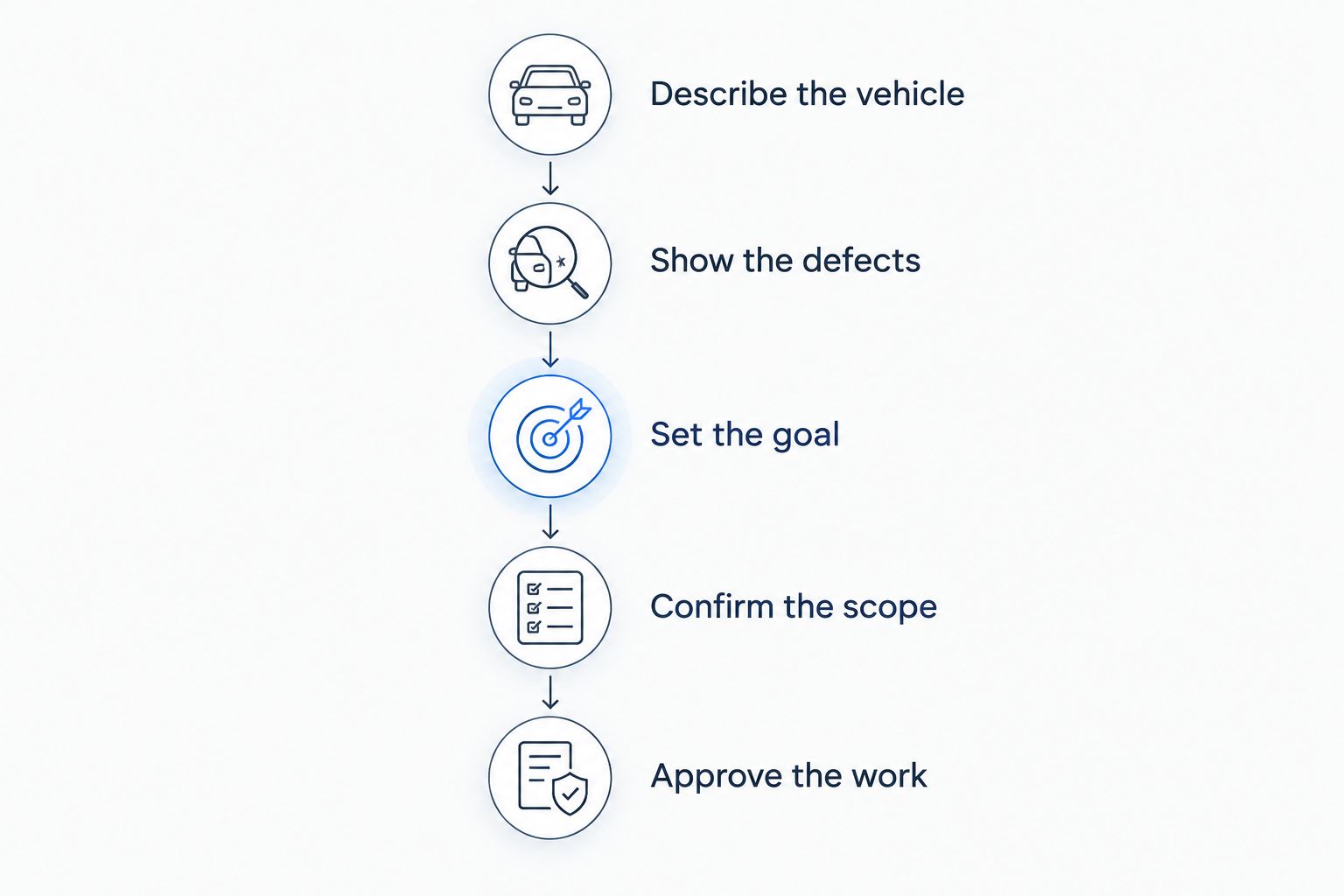
Use this sequence for a 2026 quote request. It helps the detailer understand the job and gives you a clear basis for comparing the response.
- Describe the vehicle. Provide the make, model, paint color, and any known paint repairs. Mention existing ceramic coating or previous correction if you know about it.
- Show the defects. Send overall views and close-up photographs of the areas that concern you. Include different viewing angles without editing the images to exaggerate or hide marks.
- Set the goal. Explain whether you want better overall gloss, attention to specific scratches, or preparation for ceramic coating. These are different priorities.
- Confirm the scope. Ask which panels, preparation steps, correction work, and protective treatment are included. Request an explanation of defects expected to remain.
- Approve the work. Confirm the written scope and ask how any changes after inspection will be handled. Book after you understand what you are authorizing.
Photographs help explain your concerns, but they do not establish scratch depth or paint condition on their own. Treat a photo-based estimate as a starting point when an inspection is still required.
For an Orange County mobile appointment, provide your location and describe the proposed work area. Ask the service provider to confirm whether that setting is suitable for the requested work; mobile detailing does not make every parking space appropriate for correction or coating.
Spiffy Me offers mobile interior and exterior detailing and ceramic coatings. Ask whether paint correction is included in the proposed service, available as separate work, or outside the quote before making booking arrangements.
Request a detailing quote
Describe your vehicle, paint concerns, and Orange County location. Confirm the service scope before booking.
Is paint correction worth it before ceramic coating?
Paint correction is worth discussing before ceramic coating when visible, polishable defects bother you. Inspect the paint first, because coating and correction have different purposes.
The advantage of correcting suitable defects beforehand is that you establish the finish you want to protect. The drawback is additional work when you might already find the existing appearance acceptable.
Do not authorize correction solely because the vehicle is receiving a coating. Ask the detailer to show you the defects and explain the proposed improvement before you decide.
Can paint correction remove every scratch?
Paint correction cannot remove every scratch. Polishing works by abrading the finish, so a defect can be too deep to remove safely through correction.
Marks involving missing paint, peeling clear coat, or damage requiring refinishing need a different assessment. Ask the technician to distinguish improvement from removal and identify areas that should be left alone.
A good outcome is an agreed improvement within the paint’s limits. A promise of a flawless finish without inspecting those limits is not a useful basis for booking.
Should you choose the lowest paint correction quote?
Choose the clearest suitable scope, not the lowest unexplained quote. First confirm that the proposals cover the same panels, preparation, correction goal, and final protection.
Then compare exclusions and approval terms. A higher quote is not proof of better work, and a lower quote is not proof that the scope meets your needs.
For 2026 booking decisions, keep the written proposal with your appointment details. It gives you a shared reference when reviewing the vehicle before and after the service.
FAQ
How much does paint correction cost for my car?
Paint correction requires a vehicle-specific quote based on paint condition, treatment area, and the agreed result. Request a written breakdown of preparation, correction, and final protection so you can compare equivalent work.
Does an exterior detail include paint correction?
An exterior detail does not automatically include paint correction. Confirm whether machine polishing and defect correction appear explicitly in the service scope.
Is paint correction the same as ceramic coating?
Paint correction and ceramic coating are different services: correction improves suitable existing paint defects, while coating adds a protective treatment. Ask for each service to be identified separately in your quote.
Can I get a paint correction quote from photos?
Photos can support an initial estimate, but they do not establish scratch depth or paint condition on their own. Ask whether an inspection is required before the scope is finalized.
Do new cars need paint correction before coating?
A new car needs a paint assessment, not an automatic correction recommendation. Decide based on the visible condition and the finish you want to protect.
Does Spiffy Me offer paint correction with ceramic coating?
Spiffy Me provides mobile detailing and ceramic coatings for Orange County car owners; confirm paint correction directly when requesting a quote. Ask whether it is included, separate, or outside the proposed service.
What should I ask before booking paint correction?
Ask which areas will be treated, what preparation is included, which defects are expected to remain, and what protection follows. Confirm how changes to the agreed scope will be approved after inspection.
One last thing
Choose a stopping point before the polishing starts. The deepest remaining scratch is not automatically the next one that should be removed.
Tell the detailer which marks matter most, then ask which should remain to avoid unnecessary paint removal. That conversation gives your quote a practical target: improve the finish without treating perfection as the only acceptable result.


