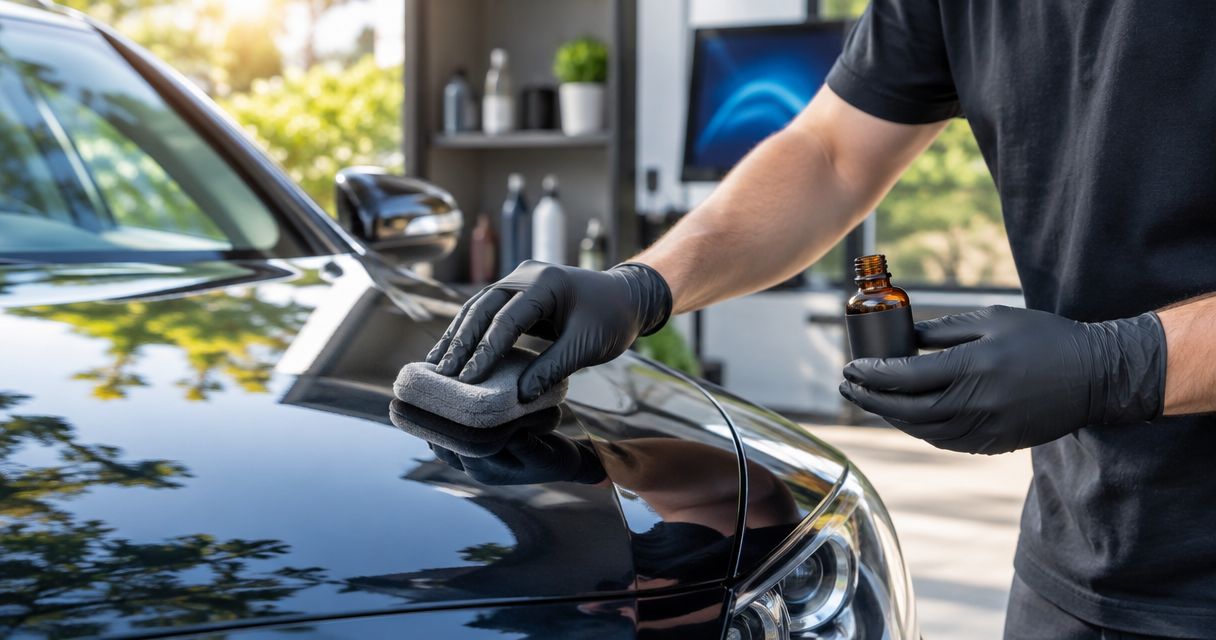
Best overall: a ceramic coating backed by relevant weathering tests. Best for Orange County owners seeking mobile application: Spiffy Me. Best DIY option: a coating with clear preparation and curing instructions. For ceramic coating UV protection in 2026, compare evidence before choosing a brand; water beading and hardness ratings do not establish UV performance.
- Choose ceramic coating UV protection using weathering evidence, not water beading or hardness claims.
- Spiffy Me provides mobile ceramic coating services for Orange County car owners seeking professional application.
- Compare the exact coating, test conditions, preparation requirements, and maintenance instructions before booking.
- Ceramic coating does not replace intact clear coat, careful washing, or covered parking.
Why this matters
A brand ranking is useful only when the products have been compared on the same basis. Different exposure conditions, application methods, and measurements cannot support a reliable strongest-to-weakest UV ranking. A familiar name does not fix that problem.
For your car, separate three decisions: whether the paint is suitable for coating, which product has relevant evidence, and who will apply it. Spiffy Me provides mobile interior and exterior detailing and ceramic coatings in Orange County. Ask which coating is proposed before treating any manufacturer's claim as a promise about your vehicle.
UV protection also needs a precise meaning. UVA covers wavelengths of 315–400 nanometers, while UVB covers 280–315 nanometers under the World Health Organization's wavelength definitions. A claim about resisting weathering is not automatically a measurement of how much radiation a coating blocks across those ranges.
What makes the best ceramic coating for UV protection?
Use these criteria to compare ceramic coatings in 2026. The best-supported choice explains what was measured, not just what the product is called.
- Relevant testing: Look for weathering or UV-exposure evidence that evaluates automotive paint protection, rather than an unrelated surface property.
- Comparable conditions: Check the substrate, exposure cycle, coating preparation, and measurement method before comparing results.
- Defined outcomes: Gloss retention, color change, cracking, and UV transmission answer different questions. Identify which outcome supports the claim.
- Exact product identity: Evidence for one coating does not automatically establish the performance of another product from the same brand.
- Practical application: Preparation, application conditions, and curing instructions must fit the vehicle and appointment setting.
- Clear maintenance: You need written care instructions and a realistic understanding of what the coating does not prevent.
Ceramic coating choices at a glance
The ranking below prioritizes buying decisions, not unverified brand superiority. It separates UV evidence from application convenience so you do not mistake a useful service feature for a laboratory result.
| Rank and option | Best for | Main advantage | Key limitation |
|---|---|---|---|
| 1. Coating with comparable weathering evidence | Buyers prioritizing substantiated UV claims | Gives you a defined basis for evaluating protection | Laboratory conditions do not reproduce every parking environment |
| 2. Professionally applied ceramic coating | Owners who want application handled for them | Puts inspection, preparation, and application in a service workflow | Professional application alone does not establish stronger UV protection |
| 3. DIY ceramic coating | Owners prepared to follow technical instructions | Gives you direct control over preparation and application | Application errors and unsuitable conditions remain your responsibility |
| 4. Ceramic spray or maintenance product | Owners maintaining an existing protection system | Can fit a manufacturer's specified maintenance routine | The ceramic label alone does not establish standalone UV performance |
1. Tested ceramic coating: best for evidence-first buyers
A coating supported by relevant, comparable weathering evidence deserves priority when UV protection is your main objective. The useful evidence identifies the exact product, the coated surface, the exposure conditions, and the measured result. A headline about protection without that context is not enough.
Ask whether the test measures the coating's own resistance to deterioration or protection of the paint beneath it. Those are different claims. A material can remain intact during exposure without demonstrating a particular reduction in paint fading.
Tested ceramic coating pros:
- Gives you something more specific than promotional wording to evaluate.
- Helps distinguish measured weathering outcomes from appearance claims.
- Allows meaningful comparison when competing results use equivalent methods.
Tested ceramic coating cons:
- Accelerated exposure does not directly establish a lifespan on your car.
- Results depend on the tested surface and application conditions.
- A strong result for one outcome does not prove every protection claim.
Best for: You want the strongest available basis for a UV-related purchase decision and will read the supporting documentation.
For your 2026 shortlist, ask for the test report or technical summary before choosing by brand recognition. Buy only when the evidence supports the specific protection claim you care about.
2. Professional ceramic coating: best for outsourced application
Professional ceramic coating is a service choice, not a separate UV-performance category. Spiffy Me provides ceramic coating services for Orange County car owners who want mobile application rather than a DIY project. Confirm the proposed product and service scope when requesting a quote.
Professional application does not make every coating equivalent. You still need to know how the paint will be assessed, which preparation steps are included, and what conditions the manufacturer requires during application and curing.
Professional ceramic coating pros:
- Moves preparation and application work out of your hands.
- Creates an opportunity to discuss existing paint defects before coating.
- Lets you request a written scope and aftercare instructions together.
Professional ceramic coating cons:
- The service label alone says nothing about comparative UV performance.
- Preparation and correction are not automatically identical between quotes.
- Mobile application requires a suitable working environment for the selected product.
Best for: You want a service provider to handle the work and explain the coating system.
Spiffy Me is a fit for Orange County car owners seeking mobile ceramic coating services. Buy after confirming the exact coating, preparation scope, working conditions, and aftercare requirements—not solely because application is professional.
3. DIY ceramic coating: best for instruction-focused owners
DIY ceramic coating puts product selection, surface preparation, application, and curing under your control. Choose this route because you can follow the full process, not because applying a liquid sounds simple. Manufacturer instructions should guide the work from the start.
Read the instructions before opening the product. Check surface compatibility, environmental requirements, application technique, and restrictions during curing. If your available workspace does not meet those requirements, change the plan rather than improvising around them.
DIY ceramic coating pros:
- Gives you direct control over each preparation step.
- Lets you review product documentation before committing to application.
- Makes the exact coating identity clear for future maintenance.
DIY ceramic coating cons:
- Uneven application can leave visible residue or high spots.
- Paint correction requires separate skills and equipment.
- You must manage the workspace and curing restrictions yourself.
Best for: You have a suitable workspace and are willing to follow detailed instructions.
For a DIY purchase in 2026, do not use ease of application as evidence of UV performance. Those are separate selection criteria. Buy only when both the product evidence and application requirements fit your needs.
4. Ceramic maintenance spray: best for specified aftercare
A ceramic maintenance spray belongs in this comparison because the word ceramic appears on products with different intended uses. Packaging format and terminology do not establish equivalent protection. Read whether the product is intended as standalone protection, maintenance for an existing coating, or both.
For a coated car, follow the coating manufacturer's maintenance guidance. Adding an unrelated product can change surface behavior and make it harder to judge the underlying coating from water beading alone.
Ceramic maintenance spray pros:
- Can serve a defined role in a specified maintenance routine.
- Gives you an opportunity to maintain protection during regular care.
- Provides written compatibility and use instructions when properly documented.
Ceramic maintenance spray cons:
- The ceramic label does not establish a measured UV-blocking capability.
- Strong water beading does not prove protection against paint fading.
- A maintenance product is not automatically a substitute for the original coating.
Best for: You already have a protection system and need its recommended aftercare.
Do not rank a spray above or below a coating based on the label alone. Buy for a documented maintenance purpose; skip it as a UV upgrade when that claim lacks supporting evidence.
Three claims that do not establish UV protection
Hardness
A hardness rating describes resistance to a particular form of mechanical marking under specified test conditions. It is not a sunscreen rating. A pencil-hardness claim does not tell you how much UVA or UVB reaches the paint.
Water beading
Beading describes how water behaves on a surface. It does not measure UV transmission or paint-color retention. A photograph of tight water droplets cannot establish which ceramic coating offers stronger UV protection.
Gloss
Gloss describes appearance, not a complete protection profile. Preparation can improve gloss before a coating is applied, so an attractive finished photograph cannot isolate the coating's contribution. Ask for the evidence behind the UV claim separately.
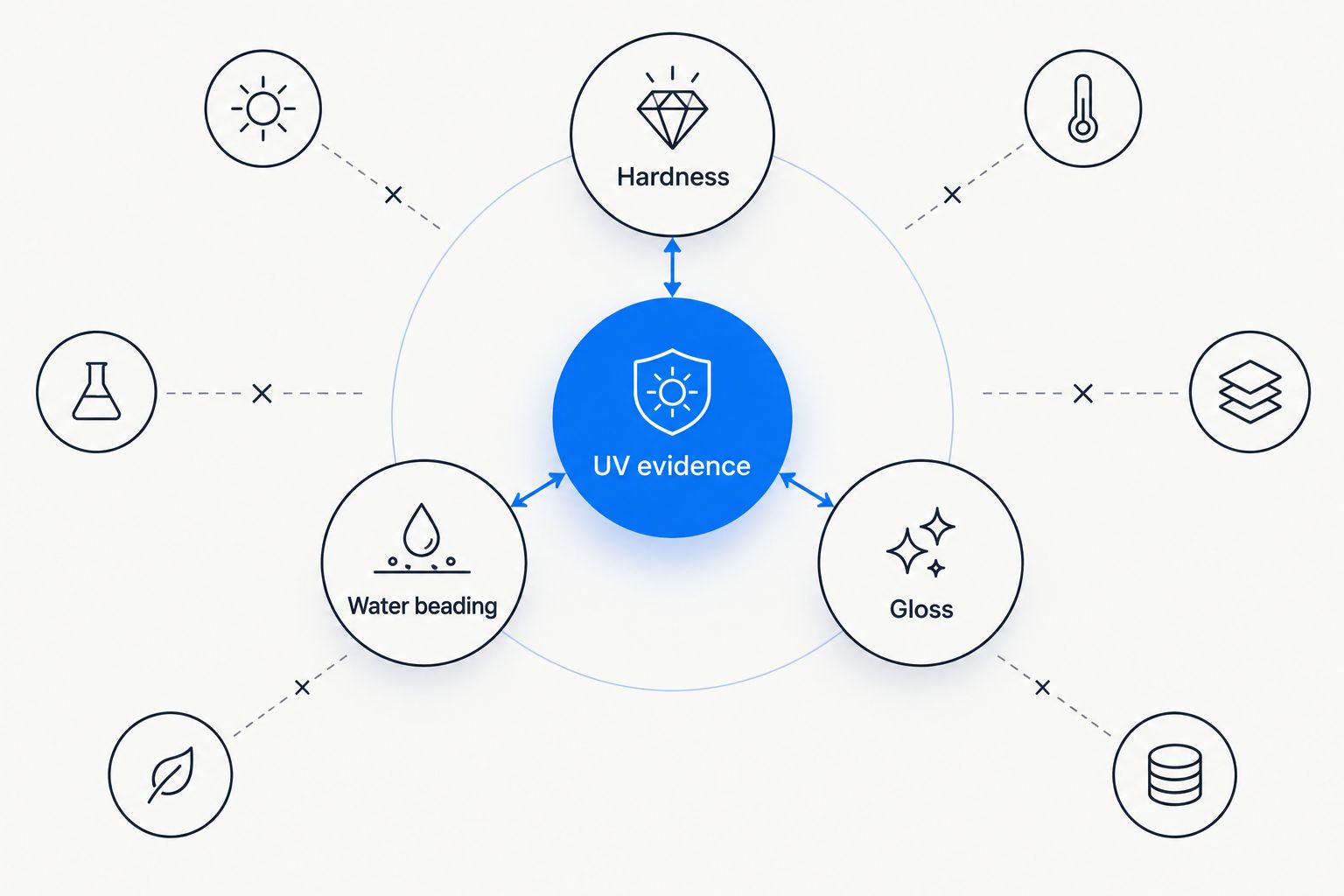
How the ranking works
This 2026 ranking puts relevant evidence first, then separates professional application, DIY application, and maintenance. Those categories answer different buying questions. They are not substitutes for a controlled comparison between named coating products.
A defensible brand leaderboard requires comparable product-level results. Without that basis, assigning first place for UV protection would turn a purchasing guide into an unsupported claim. Choose the documented coating system before choosing the most persuasive headline.
What to send with your quote request
Give the detailer enough information to discuss preparation and application. Send 4 photos: the hood, roof, one representative side panel, and any damaged area. Photographs help explain your concerns, but they do not replace a paint inspection.
Include the vehicle's make and model, usual parking conditions, known repainting, and any existing coating. Describe peeling, fading, scratches, or water spots directly. Do not assume a coating will repair them.
Ask these questions before booking:
- Which exact coating are you proposing?
- What evidence supports its UV-related claims?
- Which preparation steps are included in the quote?
- Is paint correction included, optional, or unnecessary for this vehicle?
- What workspace and weather conditions are required?
- What restrictions apply after application?
- Which maintenance products and washing methods should I use?
Request a written total and an itemized explanation of preparation, correction, and coating work. Use the contact page to request a quote and confirm the booking process, location suitability, and service scope before committing.
Request a ceramic coating quote
Share your vehicle details and ask about coating selection, preparation, and aftercare.
Which ceramic coating should you choose?
For a 2026 purchase, choose the coating with the clearest relevant evidence and an application plan you can actually follow. If you want professional mobile application in Orange County, request a ceramic coating quote from Spiffy Me and confirm the proposed product before booking.
If your clear coat is peeling or the paint needs repair, address that condition first. A coating is not a replacement for missing clear coat, and surface protection does not reverse existing paint damage.
FAQ
What's the best ceramic coating brand for UV protection?
Choose an exact coating product supported by relevant, comparable weathering evidence rather than selecting by brand alone. Hardness, gloss, and water beading do not establish which brand protects paint best against UV exposure.
Does ceramic coating block all UV rays?
Do not assume a ceramic coating blocks all UV rays. Any specific blocking claim needs product-level evidence identifying the wavelength range, test method, and measured result.
Does a higher hardness rating mean better UV protection?
No. Hardness and UV performance describe different properties, so a hardness rating cannot establish protection against fading or weathering.
Is professional ceramic coating better than DIY for UV protection?
Professional application alone does not establish better UV protection. Compare the exact products and their evidence, then decide who can meet the preparation and application requirements.
Can ceramic coating fix paint that has already faded?
Ceramic coating does not repair failed clear coat or restore missing paint. Have the surface assessed so correction or repair needs are addressed before coating.
Does ceramic coating replace covered parking?
No. Covered parking reduces direct exposure, while a coating is a surface treatment with product-specific capabilities and limitations. Use both when practical rather than treating them as interchangeable.
How do I compare ceramic coating quotes in Orange County?
Compare the exact coating, preparation scope, correction work, application requirements, and written total. Ask each provider to explain UV claims separately from gloss, hardness, and expected maintenance.
One last thing
Ask what is being protected, not just whether the coating survives. A test showing that a coating resists UV-related deterioration is not automatically proof that it prevents the paint underneath from changing color. That distinction is more useful than an unsupported brand ranking.
Keep the product name, application record, and aftercare instructions with your vehicle records. You will have a clear reference when arranging maintenance or discussing reapplication.


