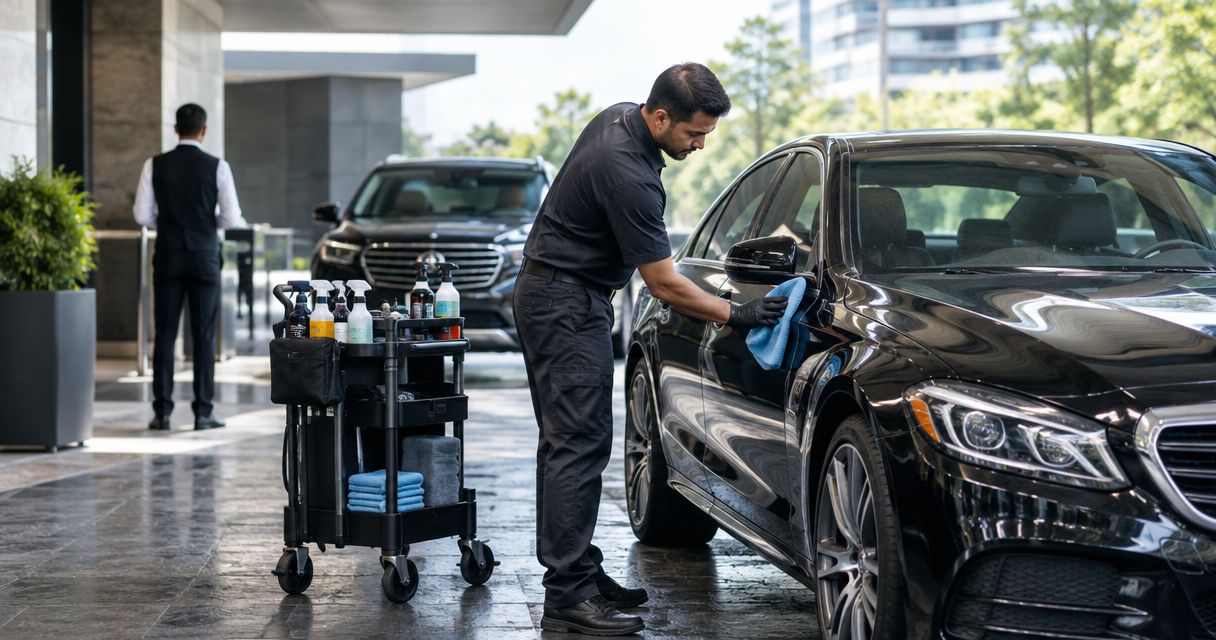
Instead of manually chasing owners, finding keys, and checking pickup times for every detailing request, build mobile detailing for valet parking service around owner approval, a confirmed work area, and documented vehicle handoffs. Use the workflow below to coordinate a mobile detailer without treating a parked car as permission to start work.
- Mobile detailing for valet parking service needs owner approval, property permission, and a confirmed pickup deadline.
- Spiffy Me provides mobile interior detailing, exterior detailing, and ceramic coatings for Orange County car owners.
- Keep valet dispatch responsible for vehicle movements and record every key handoff.
- Confirm the service scope and site requirements before promising a finished vehicle at pickup.
Why this matters
A valet ticket records a parking transaction. It does not establish the owner's detailing instructions, the property's permission to perform work, or the detailer's acceptance of a deadline. Keep those decisions separate.
Spiffy Me mobile detailing is best suited to Orange County car owners who want interior or exterior care coordinated around where their vehicle is parked. For a proposed valet appointment, contact the detailing team with the location, vehicle condition, requested service, and pickup deadline. Confirm the arrangement before presenting it as booked.
For your 2026 operating procedure, make the release decision explicit: the vehicle stays out of the detailing queue until the owner, property representative, and detailer have each confirmed their part. A shared record helps staff see that decision; it does not replace it.
Before you start
- Get the right permissions. You need the vehicle owner's authorization, a property contact who can approve the work area, and a valet supervisor responsible for keys and vehicle movements. Confirm the proposed location with the detailer rather than assuming every parking space works.
- Prepare a shared job record. Use your existing dispatch system, a shared spreadsheet, or a paper worksheet accessible to authorized staff. Record the valet ticket reference, vehicle identification, owner contact, requested work, approved scope, pickup deadline, work location, and handoff history. Keep personal information out of public-facing boards.
- Resolve the site constraint first. A garage or parking agreement does not automatically permit detailing. Ask about water and power needs, ventilation, runoff handling, equipment access, and pedestrian clearance before scheduling. Do not assume the detailer supplies utilities or that the property permits exterior washing.
No dedicated integration is required for this workflow. The bold labels below are suggested fields and statuses for your own job record, not verified buttons or settings in a particular booking system.
Owner approval and service scope
Set up the request record
- Create one record per vehicle. Start with Valet ticket, Vehicle, Owner contact, and Pickup deadline. Match the vehicle to the ticket before adding any service instructions. Do not identify a car by color alone.
- Record the owner's request. Add Requested service and Priority concerns. Describe the actual need, such as interior debris or exterior contamination, rather than selecting a service solely because the vehicle is already parked.
- Request a written scope. Ask the detailer to specify the proposed work, exclusions, site requirements, and expected completion window. Get a quote before seeking final approval; do not substitute a valet employee's estimate for the detailer's assessment.
- Capture authorization. Use Owner approval to record the agreed scope and the approval reference. State who is responsible for payment and who can authorize changes. Keep unapproved additions out of the work order.
Choose the service by the owner's goal and the confirmed parking window. The following comparison describes planning considerations, not named packages or guaranteed outcomes.
| Service | Best for | Practical benefit | Constraint to confirm |
|---|---|---|---|
| Interior detailing | Owners prioritizing the cabin | Focuses the appointment on interior cleaning | Access to personal belongings, cleaning scope, and drying requirements |
| Exterior detailing | Owners prioritizing exterior cleaning | Keeps the agreed work focused on exterior surfaces | Permitted work area, runoff handling, and vehicle condition |
| Ceramic coating | Owners planning a separate protective treatment | Adds a coating treatment to an agreed preparation process | Preparation, application conditions, curing instructions, and release timing |
Expected result: You have a vehicle-specific request with an approved scope, a responsible payer, and a pickup deadline. An inquiry is not yet a confirmed appointment.
Site approval and appointment confirmation
Configure the work location
- Name the property approver. Add Property approval and record who approved the proposed work area. Include any restrictions on operating hours, vehicle movements, equipment placement, or washing.
- Describe the actual space. Record Work location precisely enough that dispatch and the detailer can find it. Check access routes, door-opening clearance, pedestrian paths, and whether moving the vehicle blocks retrieval traffic.
- Confirm operating requirements. Ask the detailer what the requested work needs at this location. Document utility arrangements and wastewater handling with the property representative. Check applicable local requirements rather than assuming permission covers every activity.
- Reconcile the timing. Give the detailer the owner's pickup deadline and ask whether the requested scope fits. Include time for vehicle movement, inspection, and key return instead of treating the entire parking stay as working time.
- Confirm the appointment. Set Booking status to Confirmed only after the detailer accepts the location, scope, and timing. Keep a separate Awaiting confirmation status for requests still being discussed.
Use the guide to mobile detailing appointment length to prepare your questions, then get timing for the actual vehicle. A general guide is not a completion commitment.
Expected result: The property and detailer agree on where the work happens and what the appointment requires. Dispatch has a confirmed plan rather than an assumption.
Vehicle handoff and work authorization
Establish the release gate
- Check the arrival record. Match the physical vehicle to Valet ticket and Vehicle. Document visible condition under the property's normal intake procedure, and preserve that record for the later handoff.
- Confirm belongings and access. Ask the owner to remove valuables and identify anything staff should not move. Record restrictions in Access notes. Obtain instructions before moving items that prevent the approved cleaning.
- Assign vehicle movement. Record Movement owner so everyone knows which authorized person moves the car. Do not leave the detailer and valet team to infer responsibility from who holds the keys.
- Document the key transfer. Use Keys released to, Release time, and Vehicle location. Keep the key record within the authorized team and follow the property's key-control rules.
- Authorize the agreed work. Set Work status to Ready for service only after approval, location, and access checks are complete. Tell the detailer to request approval before changing the scope.
Build your 2026 handoff worksheet around 3 checkpoints: Owner approval, Site approval, and Vehicle handoff. These are proposed controls, not claims about an existing booking platform.
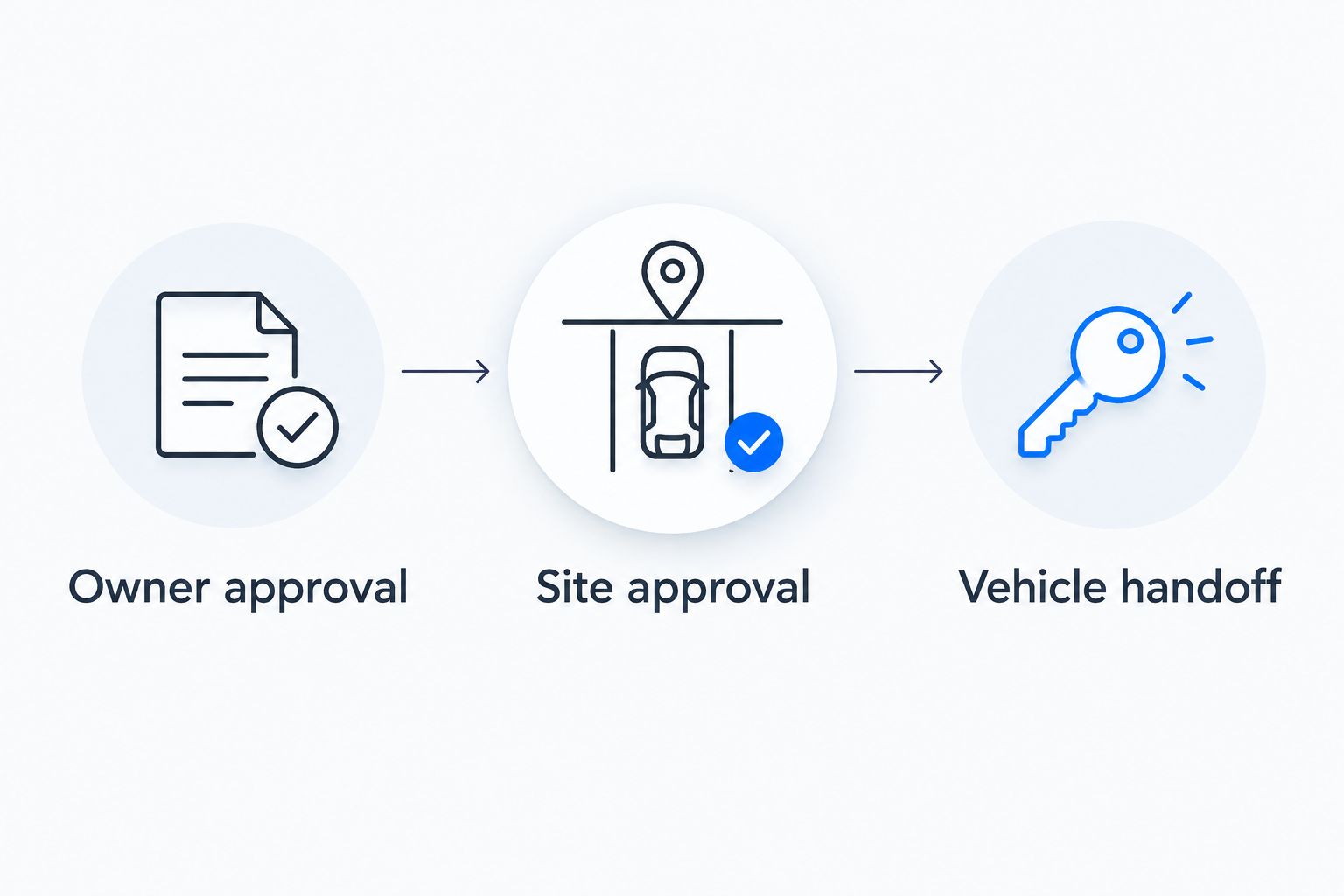
The release gate separates permission to park from permission to perform work. Expected result: The correct vehicle reaches the approved work area with a recorded condition, authorized scope, and traceable keys.
Completion review and valet return
Configure the return handoff
- Request a completion update. Have the detailer report the completed work, any unresolved issues, and applicable care instructions. Keep Service complete separate from Ready for pickup.
- Review the approved scope. Compare the completion report with the owner's instructions. Record exclusions or condition-related limitations plainly; do not mark an unresolved concern as corrected simply to close the ticket.
- Check release conditions. Confirm whether cleaned surfaces need additional drying or whether a coating has handling restrictions. Follow the detailer's treatment-specific instructions rather than promising immediate normal use.
- Return custody to valet dispatch. Record Keys returned to, Return time, and Pickup location. This creates 2 documented custody handoffs: valet to service and service back to valet.
- Notify the owner. Confirm the vehicle's pickup location and relay any care instructions. If the work or deadline changed, explain the change before the owner arrives.
Use distinct completion fields in your 2026 worksheet. A finished cleaning task, a returned key, and a vehicle ready for retrieval are different facts.
Expected result: Dispatch knows where the vehicle is, who holds the keys, and whether it is ready to release. The owner receives the agreed service information without having to reconstruct the handoff.
Repeat the workflow for returning valet customers
A recurring request uses the same controls as a first appointment. Save preferences, not permanent permission to perform any future work.
- Create a new job record for each visit. Keep the current ticket, vehicle condition, and pickup deadline separate from previous appointments.
- Ask the owner to confirm the service scope for that visit. A previous interior detail does not authorize another appointment or additional work.
- Reconfirm the location with the property and detailer. A work area used previously still needs to be suitable for the current appointment.
- Carry forward care instructions only after checking that they still apply. Record new coatings, repairs, or owner restrictions when disclosed.
- Close the visit with the same completion and key-return checks.
For a recurring 2026 schedule, use a calendar entry as a planning reminder, not as proof that the owner or detailer has confirmed. Keep tentative requests visibly separate from booked appointments.
This variant suits returning customers who want consistent coordination. Its limitation is administrative: a saved preference reduces retyping, but each visit still needs current authorization and timing.
Troubleshooting
The owner requests the vehicle early
Tell the detailer and dispatch immediately. Ask what work can stop safely and what release conditions apply, then give the owner a confirmed update. Do not promise instant retrieval while work or a treatment is in progress.
The property rejects the work area
Pause the appointment before equipment is unloaded or the vehicle is moved for service. Ask the property representative and detailer to approve another location. If they cannot agree, arrange a different appointment with the owner's approval.
The vehicle needs work outside the approved scope
Keep the original authorization intact. Ask the detailer to explain the additional work and obtain the owner's decision before proceeding. Record declined work so the completion review reflects what was actually authorized.
The keys or vehicle location are unclear
Stop further vehicle movements and reconcile the last recorded handoff with the responsible staff member. Verify the ticket and physical vehicle before restarting. Never solve an uncertain handoff by trying keys across parked vehicles.
The owner reports a condition concern at pickup
Record the concern and compare the intake and completion records. Notify the responsible supervisor and detailer, then follow the agreed incident process. Avoid assigning fault or promising a remedy before the concern is reviewed.
Customize your workflow
Start your 2026 rollout with 1 vehicle per trial appointment. Check whether staff can find the approval, locate the keys, and explain the release status without asking several people. Correct unclear responsibilities before increasing the number of overlapping jobs.
Ask Spiffy Me about the requested detailing service and proposed Orange County location before adding a date to the confirmed valet schedule. Confirm the scope first; present a booking only after it is accepted.
Track exceptions in plain language: missing authorization, unsuitable work area, changed pickup deadline, or delayed key return. Those records show which part of your process needs correction without inventing a performance target.
Request a detailing quote
Share your vehicle, requested service, Orange County location, and pickup deadline.
FAQ
How do I arrange mobile detailing for valet parking service?
Get owner authorization, property permission, and confirmation from the detailer before releasing the vehicle for work. Record the approved scope, pickup deadline, vehicle location, and key handoffs in a shared job record.
Does a valet ticket authorize someone to detail my car?
Treat detailing authorization as a separate approval from the valet ticket. Confirm the requested work and who can approve changes before service starts.
Can mobile detailing happen in a parking garage?
Confirm the specific garage and requested service with both the property representative and the detailer. Access, ventilation, utilities, runoff handling, and operating restrictions need to be resolved before booking.
Can I get ceramic coating while my car is with valet parking?
Arrange ceramic coating only after the detailer confirms the location, preparation needs, appointment timing, and release instructions. Do not assume the coating process fits an ordinary valet stay.
Does Spiffy Me offer a valet software integration?
This guide describes a coordination workflow, not a Spiffy Me software integration. Use an authorized shared record and confirm service arrangements directly with the business.
What happens if I need my car before detailing is finished?
Notify valet dispatch immediately so staff can coordinate a safe stopping point and confirmed retrieval plan with the detailer. Release timing depends on the work underway and applicable care instructions.
What should I send when requesting a detailing quote?
Send the vehicle details, condition concerns, requested service, proposed location, and pickup deadline. Ask for the scope, exclusions, site requirements, and timing before approving the appointment.
One last thing
A completion message is not a custody handoff. The detailer can finish the agreed work while the keys remain with the service team or the vehicle remains outside the normal retrieval area.
Make the final question operational: can valet dispatch identify the vehicle, locate its keys, and confirm its release instructions from the record? Close the job only when that answer is yes. That final check connects a completed detailing appointment to the owner's actual goal: collecting the right vehicle without confusion.


