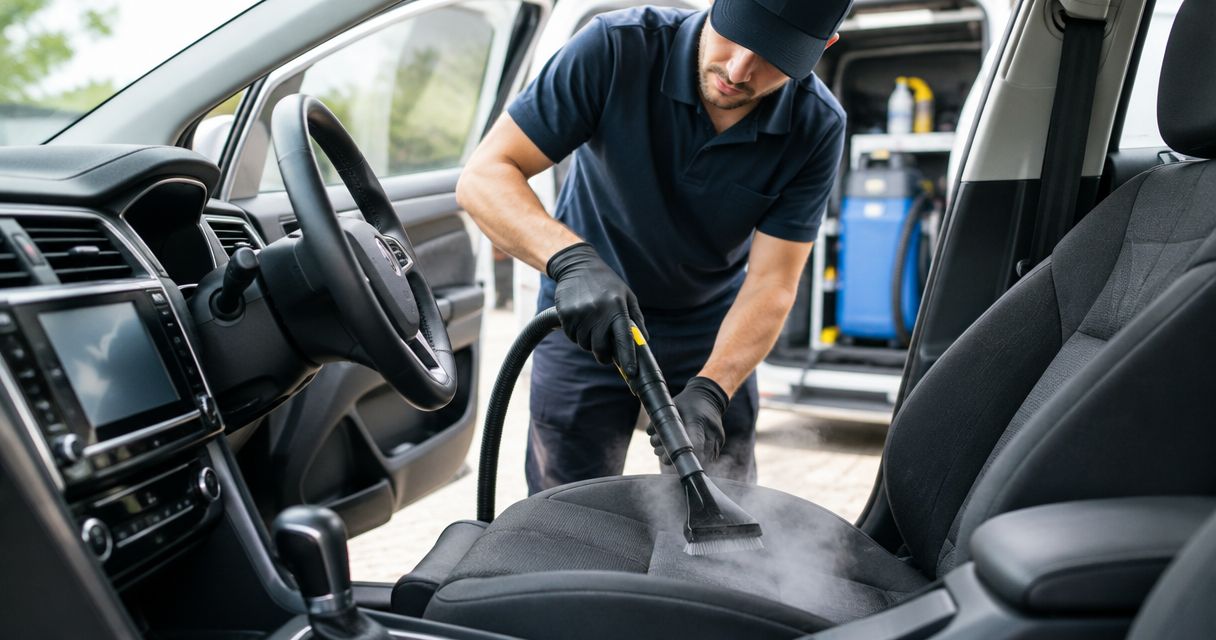
Yes, mobile detailing can remove a musty smell when the source is accessible contamination that can be cleaned and thoroughly dried. It cannot reliably resolve mold odor caused by an active leak, contaminated padding, or an untreated ventilation problem. Fix the moisture source before treating the smell, and disclose suspected mold before booking.
- Can mobile detailing remove mold smell car owners notice? Yes, when accessible contamination and moisture are addressed.
- Spiffy Me offers mobile interior detailing in Orange County; confirm whether suspected mold falls within the service scope.
- Recurring mildew odor needs source investigation, not stronger fragrance.
- Floodwater, hidden growth, and persistent dampness require assessment beyond routine interior detailing.
Can mobile detailing remove mold or mildew smell from a car?
Mobile detailing can help when the odor comes from removable damp belongings or contamination on accessible interior surfaces. The result depends on what is wet, how far contamination extends, and whether the interior can dry completely.
Spiffy Me is best for Orange County car owners seeking mobile interior detailing. Suspected mold requires a separate scope discussion: do not assume a standard interior detail includes mold remediation, carpet removal, or leak repair.
Use this comparison to choose the right starting point for a 2026 service request:
| Starting point | Best for | Main benefit | Main limitation |
|---|---|---|---|
| Mobile interior detailing | Accessible interior dirt and odor sources after moisture is controlled | Cleans reachable cabin surfaces | Does not establish that hidden materials are clean or dry |
| Leak diagnosis and repair | Dampness that returns after rain or washing | Addresses incoming water | Does not clean contaminated upholstery |
| Automotive mold assessment | Visible growth, flood history, or suspected hidden contamination | Determines the appropriate scope of work | Can involve removal or replacement beyond detailing |
| Ventilation-system diagnosis | Odor strongest when the fan starts | Investigates a possible airflow-system source | Does not address a separate wet carpet problem |
These services address different problems. A clean seat does not prove the material beneath it is dry, and repairing a leak does not remove contamination already inside the cabin.
Why this matters
A mildew smell is a reason to investigate, not a diagnosis. Odor alone cannot identify the organism, locate every affected material, or establish whether a vehicle is safe for an occupant with asthma or mold sensitivity.
A fragrance-heavy interior can also make the result difficult to judge. Ask for an assessment based on the condition of the materials and the moisture source, rather than whether the cabin smells pleasant immediately afterward.
For your 2026 booking, separate the job into source control, appropriate cleaning, and complete drying. Leaving out any of these turns an odor complaint into repeat work.
Start with the source, not an odor treatment
Before choosing a service, describe where the smell is strongest and when it appears. You do not need to pull apart the interior to provide useful information.
Damp belongings or a contained spill
Wet towels, forgotten clothing, and damp removable mats are straightforward places to check. Remove loose belongings and tell the detailer about any spill, including what spilled and where it went.
Best for: an initial interior-cleaning assessment when the affected area is accessible and there is no evidence of a continuing leak. The limitation is depth: a small surface mark does not establish how far liquid traveled beneath upholstery or carpet.
Damp carpet or repeated water entry
Carpet that becomes wet again after rain points to a different job from routine cleaning. Tell a repair provider when the dampness appears and which part of the cabin is affected.
Best for: leak diagnosis before another detail. Cleaning has value after the source is controlled, but repeated extraction cannot compensate for water continuing to enter the vehicle.
Odor from the ventilation system
A musty smell that becomes strongest when the fan starts deserves ventilation-system diagnosis. Report whether it happens with outside air, recirculation, air conditioning, or fan-only operation.
Best for: an automotive HVAC assessment rather than assuming a seat shampoo will solve the problem. A cabin filter inspection can be relevant, but replacing a filter alone does not establish that the entire system is clean.
Visible growth or flood history
Visible suspected growth, widespread contamination, or known flood exposure changes the scope. Tell the provider before anyone arrives, and avoid brushing or disturbing affected materials to prepare the car.
Best for: a qualified assessment before routine detailing. Flood exposure also raises vehicle-condition questions beyond upholstery cleaning, so involve an automotive repair professional rather than treating the issue as odor alone.
What should a responsible cleaning plan include?
A useful plan explains what will be inspected, what will be cleaned, and what conditions would stop the work. It should also distinguish cleaning from repairs and replacement.
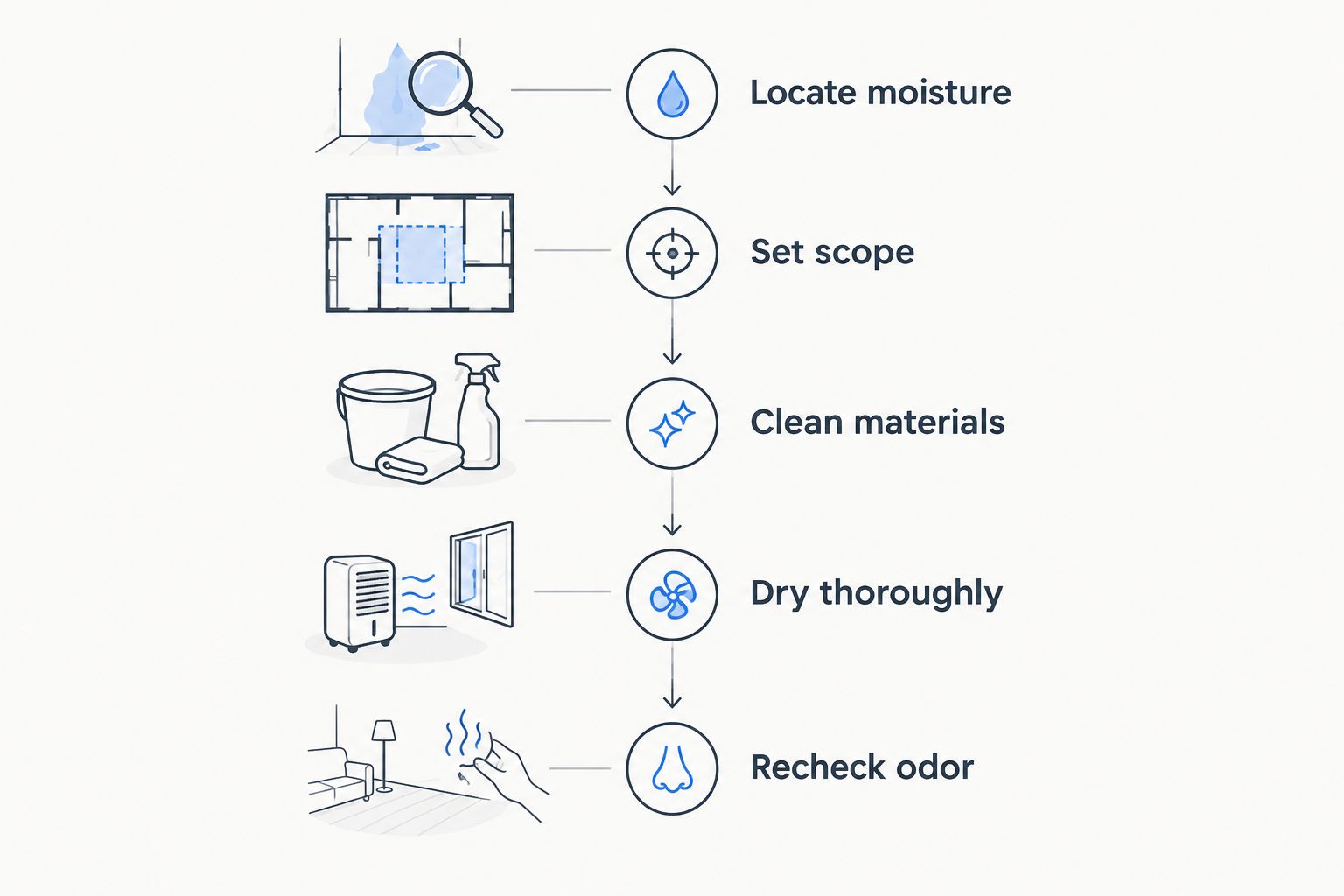
Use these 5 steps to review a proposed service:
- Locate moisture. Explain the spill, leak, damp area, or operating condition associated with the odor. Ask what the provider can inspect without disassembly.
- Set scope. Confirm which surfaces are included and whether suspected mold is accepted. Establish who handles work outside that scope.
- Clean materials. Ask how the method suits the upholstery, trim, and manufacturer care instructions. More water or stronger chemicals are not automatically better.
- Dry thoroughly. Discuss how wet materials will dry and what happens if padding remains damp. Surface dryness alone does not establish that underlying materials are dry.
- Recheck odor. Evaluate the cabin after cleaning and drying, without relying on fragrance. Report any return of the smell under the conditions that originally triggered it.
These steps are a decision checklist, not a claim that every mobile detailer performs mold remediation. Confirm the actual service before authorizing work.
If the proposed plan jumps directly from smelling the cabin to applying a deodorizer, ask how the source will be addressed. An odor treatment is not evidence that contaminated material has been removed.
Why mold-smell removal varies
The practical differences come from the condition of the vehicle, not the label on a detailing package. For a 2026 quote, describe these factors clearly:
- Moisture source: a removed wet item and an unrepaired water leak require different next steps.
- Affected material: a reachable hard surface presents a different cleaning problem from absorbent padding beneath carpet.
- Extent: a contained area and contamination across several interior spaces need different assessments.
- Access: seats, trim, or carpet can conceal the source; do not assume removal is included in a mobile detail.
- Drying conditions: adding moisture during cleaning creates a drying requirement that the service plan must address.
- Ventilation involvement: an odor associated with airflow calls for investigation beyond visible upholstery.
Ask the provider to explain which of these factors applies to your vehicle. A clear boundary is more useful than an unconditional promise to eliminate every smell.
What should you avoid before the appointment?
Do not try to make suspected mold look less serious before the provider sees it. Accurate photos and an honest history help the provider decide whether to accept the job or recommend another specialist.
Avoid dry brushing suspected growth or using an ordinary household vacuum on it. Disturbing mold can release particles into the air; a routine cleanup method is not automatically appropriate for contaminated materials.
Do not soak the carpet with household cleaners or mix cleaning chemicals. Follow vehicle care instructions and product labels, and leave treatment selection to a provider who has accepted the condition and explained the method.
Be cautious about ozone presented as a complete solution. EPA guidance on ozone generators explains that ozone is a lung irritant and that concentrations within public-health limits are generally ineffective at controlling indoor air pollution; an ozone treatment does not replace moisture control or removal of affected material.
How do you request the right quote?
Prepare 4 photos if the areas are accessible without disturbing suspected growth: the affected surface, the surrounding floor, the underside of a removable mat, and a wider cabin view. Photographs help communicate the problem; they do not establish the extent of hidden contamination.
For a clear 2026 inquiry, include:
- Your vehicle make, model, and interior material, if known.
- When the odor started and whether it follows rain, washing, or fan use.
- Any known spill, leak, flood exposure, or previous odor treatment.
- Whether materials currently feel damp or show suspected growth.
- Your Orange County location and the proposed parking arrangement.
Contact Spiffy Me to ask whether the condition fits its mobile interior detailing scope. Request a written description of included surfaces, exclusions, drying arrangements, and any inspection needed before the quote is finalized.
Use the contact page to start that discussion. Describe suspected mold directly rather than booking it as an ordinary refresh.
Request an interior detailing quote
Share the odor history, damp areas, and photos; ask whether the condition fits the service scope.
Can a detailer guarantee the mold smell will never return?
No detailer can establish a lasting result from fragrance or surface cleaning alone. A meaningful commitment needs a defined scope and a clear explanation of what happens if the odor returns.
Ask whether follow-up covers the treated area and what conditions fall outside the service. Do not assume a policy exists unless the business confirms it in writing.
If the smell returns, report when it happens rather than requesting a stronger scent. Recurrence after rain, after the cabin stays closed, or when the fan starts provides useful information for the next inspection.
Does a clean smell mean the car is safe?
No. A clean smell does not verify that a car is free of mold or suitable for every occupant. Likewise, a musty smell alone does not establish the extent of contamination.
If you experience symptoms in the vehicle, stop treating the issue as a cosmetic complaint and seek appropriate medical advice. People with asthma, mold allergies, or immune-system concerns should discuss exposure questions with a healthcare professional rather than relying on a detailer's odor assessment.
What should you check after the interior dries?
Make 2 checks part of the handover: review the treated area's condition and confirm the drying instructions. Ask what was accessible, what remained uninspected, and whether any materials need further attention.
Once the vehicle is dry, assess the original trigger conditions when practical. If rain previously caused dampness, a freshly cleaned cabin on a dry day does not prove the water-entry problem is resolved.
For your 2026 service record, keep the work description and note any recurrence. Judge the result by a controlled moisture source and an appropriate cleaning outcome, not by the strength of the finishing fragrance.
FAQ
Can mobile detailing get rid of mildew smell permanently?
Mobile detailing can produce a lasting improvement when the odor source is accessible, properly cleaned, and kept dry. An active leak or untreated hidden contamination can cause the smell to return.
Will shampooing my car seats remove mold?
Seat shampooing alone does not establish that mold has been removed from every affected layer. The provider needs to assess the material, contamination, and drying requirements before choosing a method.
Should I book a regular detail if I can see mold?
Disclose visible suspected mold before booking a regular detail. Ask whether the provider accepts that condition or recommends assessment outside routine detailing.
Why does my car smell musty when I turn on the AC?
A musty smell associated with airflow warrants inspection of the ventilation system. Tell the repair provider when it occurs rather than assuming upholstery cleaning will address it.
Can I drive a car that smells like mold?
Odor alone cannot establish whether a vehicle is safe for you to use. Seek appropriate assessment, and ask a healthcare professional about symptoms or individual exposure concerns.
How much does removing mold smell from a car cost in 2026?
Request an inspection-based quote that separates cleaning from leak repair, disassembly, or replacement. Vehicle condition and the accepted scope determine the work required.
Does Spiffy Me handle mold remediation?
Spiffy Me provides mobile interior detailing in Orange County; confirm suspected-mold work directly before booking. Do not assume interior detailing includes mold remediation or removal of hidden materials.
One last thing
Before authorizing another cleaning, explain exactly when the smell comes back. The trigger is useful evidence: rain points the investigation toward water entry, while fan-related odor directs attention toward the ventilation system. Neither observation proves the diagnosis, but both make the next assessment more focused than simply reporting that the car smells bad.


